Friday, September 01, 2006

More Confessions of a Self-Help Girl

Okay, so I found myself having one of "those" conversations this week.

You know, the one where you find yourself spewing self-help garbage. (Because, let's face it, it works!)

One of my go-to books on relationships is the really embarrassingly cheesy Unimaginable Life by (wait for it...) Kenny and Julia Loggins, which, it turns out, is even more unimaginable than the authors originally claimed, as they are now DIVORCED as of 2004, a shocking little tidbit that I missed somehow in the last 2 years.

When the book (and album) came out, there was quite the media blitz in certain New Age circles. At first, just because one of the authors is ... b-music famous. And then, because it's one of THE most honest books I've read about relationships. Written by BOTH partners. Chronicling their individual AND partner trajectories. A lot of the book is taken straight from their journals, and you wince at times about their honesty, even in really ugly moments of fear and loathing.

This couple goes through a LOT. They were married for 14 years. They fought for their intimacy; they fought for their health. When they married, they promised to follow their paths even if that meant supporting each other to leave to find healing somewhere else.

And that's how it happened (at least publicly).

NOTHING on this in New Age circles. I'm DYING for a book or article or ANYTHING from either one of them (Kenny's pouty quotes during his recent reunion tour with Messina are NOT satisfying and only raise more questions, if not eyebrows).

Where's Julia's public statement? Where's Kenny's whiny tell-all?

Whatever happened to heart-blasted open honesty?

And yes, this panic is definitely about me and answering the "what if" question that we all have about love. What happens if the perfect relationship goes bad?

Where do you go? Clearly, this couple says, you go quiet (relatively). Okay, Kenny did release a new album, complete with sappy "I miss you" songs. No, really! One of the songs really is called "I miss us" or some damn thing. But that tells us very little, really.

One of Kenny's horrifying newspaper quotes is how great it was to reverse roles with his son and cry on his shoulder. If you've read the book, you know this is one of the things he loved best about Julia, how she played mommy to his hurt little-boy self. I'm thinking, dude is 52. Why not try just being the adult? Maybe Julia was exhausted being mommy to all 4 of their kids and Kenny, too. Being mommy is just not sexy, unless you're a pedophile.

This brings me to an argument I had with a man who I'd just met. He started the conversation warning the four women in the room that we were to acknowledge right-off that he was being brave to talk to us being the only man present, and he didn't want to get stabbed (or something deadly like that). He said it was ridiculous for women to expect maturity in men in relationships because men have never been taught how to be in relationship, in the way little girls are. He said, (and oh boy do I quote):

"Men are like retarded children. You wouldn't get mad at a retarded child for not knowing how to act. You have to be patient and teach them."


We didn't buy it, and I summed it up this way.

"Okay, but I don't want to have sex with a retarded child!"

For those of us who believe in non-traditional relationships, in trying to follow our connections, there is very little out there about what happens when THOSE end. The ending of abusive relationships is well-covered ground. Does that mean that healthy relationships are easier to walk away from and don't warrant comment? I don't think so! The hardest I've ever cried in my life (almost) was deciding to walk away from a fairly functional relationship that I just knew wasn't going to sustain us both. So painful!

I hope that if I were to 1) have the guts to write about my good and healthy relationship that I would also have the decency to 2) write about how it ended, if and when it does.

We need those stories, too. Even those of us who don't sleep with retarded children.

Wednesday, August 30, 2006

Codependence Cycles

I'm a product of having been marinated in family codependence and addiction.

I'm imprinted with it, ever affected by it, and that lens will be part of my perception forever.

That being said, I've spent a lot of time learning to be aware of it, getting to know how it colors my perception, my desires, my attractions, my knee-jerk responses, my fears, my insecurities, my sense of power, need for control, etc.

And of course, many of my relationships have existed somewhere on the spectrum of codependence, either asserting and living with too much distance or demanding and/or giving in to demands for too much unhealthy intimacy. Of course, true intimacy as Rilke reminds us is the optimum balance of independence and togetherness. Standing side by side, supportive but not asking for support, offering and taking without leaning, or maybe taking turns leaning from time to time.

But as a child of codependence, my hyper awareness of the cycles sometimes makes me paranoid. Perspicacity only takes you so far. Sometimes the cut and run response can be overwhelming. We're not taught how to stay when things are tough. We have no experience that someone in a downward spiral can make the choices that take them out of it. All I've ever seen is my father in crisis and then back in denial. Nothing in between. Even my mother, who claims to have done so much work on herself, seems not to know how to pull herself up short when surrounded by crazy and make different choices.

After reading an embarrassing amount of self-help books, one of the things I listen for are the old family voices that offer false proverbs and axioms in moments of fear. Last night, the shitty jewel was this old addiction standby: "To be in love is to be in craziness. If you want intimacy, you sign up for the other person's crazy. That's the way to truly be together."

And of course it's not true. And of course, it's more than just an addict's proverb. It's also the root of romaticism. Anyone see What Dreams May Come? Or read it? Buy it? They're soul mates. Everyone knows it. They both know it. But one goes crazy, and the other doesn't. He dies. She kills herself. He goes to heaven. She goes to purgatory. He goes to save her. But the only way to save her is to join her. Enter her crazy. When he does, she can see him and therefore see her own reality as false. (Spoiler alert: They make it to the other side.)

But here's my question: in moments of fear -- faced with a partner's crazy -- how do you strike the balance between holding their hand while they hurt and not being held hostage by their fear? It's terrifying. What comes up for me is, "What if I just don't know how to be there for another person in a healthy way? What if this is just an unhealthy relationship, and I'm giving in yet again? How can I trust my own reactions, much less those of a partner who's acting out of fear? But if I walk away, am I just abandoning someone I love, deepening his own traumas?"

It's haunting to hear a partner living out old fears. There's a palpable reality shift, and you can both hear it. Suddenly, one of you is not in the present. Suddenly, one of you is acting a role. There's the shimmering moment when you both can sense an opportunity for healing. Your partner can make a different choice and prove to himself that things can be different. You can demonstrate that this is not the past; you are not that ghost; things can be different. You talk through it, and suddenly, the room lightens. Your stomach unclenches. You are both in the present again, and you've chosen life and love. You've chosen health and wholeness. You're together. You're stronger. A fissure has seen light and moved to fuse.

Wednesday, August 16, 2006

Balance

Talking last night to friends about the balance of thought -- analytical, task-driven, haphazard, pin-ball kind of thought and dreamy, fleeting, intuitive, meditative kind of thought. There are some who claim the second kind, called tortoise thinking, is actually more productive and efficient than the stop-and-start rushing of the hare. Think: slow and steady wins the race.

In the same vein, having finished most of my responsibilities from school and teaching this summer, I find myself wondering how to structure my life in the months and years ahead. I sense a window of opportunity to do things differently. Do them differently every day as a matter of practice until the way I want to live is in fact the pattern of my life that doesn't take much effort to continue. Think: Newton's First Law -- bodies in motion tend to stay in motion.

What is it I want my life to be? What percentage of my year or my day should be given over to which things? In an ideal world, I would be teaching in a university setting 25-50% of my time, practicing as a planner/facilitator 25% of the time, and working creatively -- maybe teaching or maybe just writing the other 25%.

If that's the goal, how best to get there? Dividing my days doesn't seem to happen. I have friends who set aside time every day for each of their priorities: so much time for writing, so much time for conversation with friends, so much time for study, so much time for exercise -- and then everything else that life piles up on you.

With a 40-hour job at a desk, that doesn't seem to work for me. So for now, it's about splitting up my week. Yoga Mondays and Wednesdays. Tuesdays for running and outside work. Thursdays for friends. Fridays for dates. Weekend for family, work, creativity.

Reading doesn't seem to happen, unless I can get less sleep.

If there is more than I want to fit in, how does that happen? Early mornings seem unrealistic. Late nights, nothing seems as healthful as going to bed.

I know that if I don't take measures now to structure my life the way I want it, twenty years will pass before I know it, and I'll be fat, lazy, and stupid. That's my fear, anyway.

Just sitting here, the impediments to a healthy life flood my mind:
  • Not having a bedroom and therefore no reading lamp by the bed
  • Not being able to get up early
  • Not having laundry done for running clothes
  • Rainy nights that make running seem ... less than fun
  • Not having access to gym or pool (ah, to be a student...)
  • The cyclical guilt of friends or reading (if I'm doing one, I feel bad about not doing the other, ad infinitum)
I know the solution is just to do it. But life just seems to keep happening. Enter the flip side of Newton's first law: An object that is not moving will not move until a force acts upon it. It's always harder to get the ball rolling than to keep it rolling.

Awareness is part of the battle. Desire another. Now: to act.

Tuesday, August 01, 2006

Monsoon Season

We watch hate billow upward in the east
the way we analyze a coming storm,

reflexively picking up an umbrella
to shield ourselves from the worst wet,

ponder a sunnier day,
plan a night in

snuggled
by our tv,

curse the momentary inconvenience
of water waves in flooded streets,

the ineptitude of other drivers
who grew up here, too,

but seem to know less than we do
about how to drive in rain,

blithely ignore
building evidence of climate change

the way I fool myself into thinking
my meanness to you

on certain days
is a passing phase

having nothing to do
with punishing you

for those little things
I imagine you've done to me

because I didn't hear you say
you're hurting, too,

distracted,
slammed with life,

caught under the weight
of everyone's expectations

piled
on your own.

Perhaps it is unfair
to expect sunshine

in Israel
when I can't count on myself

to be nice
to the man I love

on a hard day
that didn't end in bloodshed.

Maybe I should fear
the increasing intensity of storms

in a desert state
whether or not my neighbors learn better how to drive.

Correlation
is causation

in a universe
where all is relative

and time
flows both ways.

Chaos creates order
when the tsunami crashes the butterfly's wings.

Responsibility reverses
time's tide.

It is the only thing
that can hold back the wave.

We can choose
not to let blood

the way I can bite my cutting tongue
in order to ask you

about your day
and listen to the rain

stop grief for a moment
at home.

In this way
I can expect the butterfly

to shuttle diplomacy
all the way

to the middle
east.

-- August 1, 2006, Albuquerque, NM, USA

Sunday, July 30, 2006

Party Pooper

Strangest night. Surrounded by people and a party I just can't get into. What does it mean when you're more motivated, energized, and just downright interested in picking up trash and empty glasses at a party than talking to people?

It's hiding, but it feels so productive! So much more satisfying to make order out of chaos than to try to broker a connection with anyone while yelling and trying desperately to remember a name and/or where on earth you know this person from.

As much as I love community, I'm terrorized by interactions at this level. I hate answering questions -- even good ones because how are you really supposed to trust that this person cares what you do when they're one spotting away from leaving you to talk to someone more interesting or attractive? You can't. And so I duck and cover.

Behind me, a band with woman singer is warming up. In front of me, a techno beat keeps time in the next room, making only the ice cubes dance in their own little glass cages.

In these moments, I feel so unfit to be an adult. I assumed that having fun at parties was something you grow into -- like enjoying wine or learning about mortgages. I remember all the parties I witnessed as a kid and how fun it looked. My mom's rosy cheeks. The neighbors leaving in the wee hours, their kids crashed out in front of Charlie and the Chocolate Factory in heaps.

Now? I think how good a book and cool bed would feel. How I enjoy conversation over coffee. How sometimes even a girl breakfast is too much. On the spectrum of introverted to extroverted, as strange as some of my friends might think this is, I'm actually an introvert. Being around people is ultimately draining, even though I can catch a buzz off it under the right circumstances. Right now I've got nothing to give people, and all I want is for no one to ask anything of me.

I see empty glasses; time to go.

Wednesday, July 05, 2006

Power and Place

My new pet topic.

I'm panicking because the University library has finally recovered from fire enough to know that I still have books checked out (even though they mailed me my diploma -- suckers!). Now real students are asking to check out the very same books! Oh the guilt! But I can't just turn them back in without sucking the marrow from their thin pages of bone! Oh the deeper guilt! To have had these books on my shelf for MONTHS without cracking a spine...

Here's a jewel from Edward Said, whom I'm ashamed to say I haven't read:

Just as none of us is outside or beyond geography, none of us is completely free from the struggle over geography. – 1993

How great is that?

So if anyone has copies of the following to loan me (for a while!), please let me know:
  • Places on the Margin
  • Entanglements of Power
  • Geographies of Resistance
Also helpful would be book reviews saying they're not so great and no sweat missing. Okay? Good.

Monday, June 05, 2006

Real life

Real job now. Fear of losing said job for blogging during work makes mjae a dull girl.

But this month only, I live the life I dream of.

I teach a creative writing class at a cultural center. All day long for a month with bright, interesting, talented teens. It's like taking adrenaline intravenously. Their juice juices me, and it takes all I have to stay a half-step ahead, just to ask the write questions, or at least the ones that will keep them thinking.

Today, we talked about culture, whether these days it means anything more than identity, stereotype, or skin color. They seemed shocked when I said that I think about culture as a way to posit and share values not valued by the capitalist monetary system. That historically, culture was like DNA for how to live, including how to communicate, interact, share symbols, trade, show respect, worship, etc. In some ways, I feel it is my gift to provide an opportunity to take back culture from its raggety, partial use for political gain and be able to define it in ways that makes it useful again for these up-and-coming artists who can teach us, again, how to live well and in peace and in beauty.

I have gathered some energy and precious little wisdom; tonight I gather the last of my calm that with luck can hold me through a month of teen energy surges.

May we all remember the horror of our youth and help build the bridges to connect us all, forward and back.

Wednesday, May 31, 2006

"The Dead Are Not" -- Patricia Traxler

from Slate.com

Click here to listen to Patricia Traxler read this poem.


The dead are not dead
yet. Always they take
their time, and we wait
politely, dreading
how real it will
have to be, sooner
or later, and at the
same time longing
to know that reality.

Nights, as we reach
to switch off our bed lamps
and close our eyes,
we dare it to take us
into its mouth
that smells of tar,
saltwater, sludge,
take us up then let us
tumble endlessly,
blameless again
and helpless as any new life
forced out for the first time
into the terrible light.

Wednesday, May 17, 2006

Hmmm... the Onion Got Me!

Heroic Computer Dies To Save World From Master's Thesis

May 17, 2006 | Issue 42•20

WALTHAM, MA—A courageous young notebook computer committed a fatal, self-inflicted execution error late Sunday night, selflessly giving its own life so that professors, academic advisors, classmates, and even future generations of college students would never have to read Jill Samoskevich's 227-page master's thesis, sources close to the Brandeis University English graduate student reported Monday.

Tuesday, May 16, 2006

Initial thoughts on a dissertation

I'm a planner, okay? I love dreaming of the future. Now that the thesis is done, I'm reading books on identity and place -- specifically multicultural spaces that support, enhance, and strenghten multiple ethnic and racial groups and the larger community that includes us all.

Today at lunch I was reading Geographical Identities of Ethnic America.

The following describes in tantalizing vagueness why this will be the subject of my next degree. I even thought of a title for my dissertation/book today: Leaving Room: A Politics of Freedom and Inclusion.

Sexy, huh?

Some quotes from this latest book to pique my interest:

4: “Underlying the theme that place and space and place are influential in the articulation of identity is our premise that identities are socially constructed. Constructed, as Manuel Castells (1997) points out, because identity is the source of people’s meaning and experience”

Think William James here. Race and ethnicity may not exist in any proveable way with definitions that even most of us would agree with. But the point is that people find them to be useful constructs to describe themselves, make meaning of their communities/lives, or organize for action and/or economic vitality. That’s powerful! So why don’t we understand better how identities are contested in space and how to harness the power of multiple identities to SHARE spaces. That’s where I come in.

Think about how amazing and revolutionary this idea would be – Palestine and Israel, Rio Rancho/ABQ/Bernalillo/Corrales/Santa Ana Pueblo, Barelas/Downtown, etc.

6: “two themes: 1) how space and place influence racial and ethnic identities and 2) how individuals and groups acting on their identities create spatial patterns and landscapes.”

Again, understanding how each of these processes work and being able to reverse them to be successful prescriptive – to create places that support, enhance, and strengthen multiple identies – is the real trick.

7: “collective patterns of identity can be imprinted on landscapes and places over time, transforming the landscape. Subsequent landscapes bear the imprint of the strength of the ethnic group to re-create the landscape with material and nonmaterial symbols and forms of social interaction. Language, religion, kinship patterns, settlement, agriculture, and labor patterns become visible on the cultural landscape of a region as global forces of migration become localized over time. The power of the local landscape lies in its ability to reinforce racial and ethnic identity of second and third-generation residents as well as new immigrants to the region.”

Geography takes a rather narrow and yet too specific view of this shit. There needs to be a way to bridge sociology, geography, community planning, and urban design.

12: “Geography is an important mechanism for reinforcing racial and ethnic identity and experience, and that geography is partially defined by race and ethnicity. What holds this group [of collected authors] together is an interest in raising awareness of the ties that bind North American racial and ethnic groups to their spaces and places. All the contributors also uphold a commitment to share their insights and information about a particular racial or ethnic group in the broader context of other group experiences.”

I agree with their premises and assumptions. I think it needs to go further. Geography tends to only be analytical; I would want to make it implementable and practical in a political and spatial sense. Easy enough, right?

But where? Which university? Which department? Cultural Studies? Urban Studies? Planning? Sociology? Geography?

Anyone have suggestions?

Monday, May 08, 2006

1977 (Poem) by Jeffrey McDaniel

from Alibi School

The family around the table and a silence
so compact no words can break it.

Not even a pigeon swirling through the window
can nudge mother's poorly taped grin.

Her face has the euphoric glow of a mathematician
whispering a formula into the whorl of a rose.

Her eyes are tiny stones testing the black
silk bags she lugs them in.

Since father banned television the sons stare
at the marriage dangling from the ceiling.

Each month it sinks another couple inches
until it's in their food.

No wonder they don't eat.

Tuesday, May 02, 2006

Facts about the Moon (Poem) by Dorianne Laux


from Facts about the Moon

The moon is backing away from us
an inch and a half each year. That means
if you’re like me and were born
around fifty years ago the moon
was a full six feet closer to the earth.
What’s a person supposed to do?
I feel the gray cloud of consternation
travel across my face. I begin thinking
about the moon-lit past, how if you go back
far enough you can imagine the breathtaking
hugeness of the moon, prehistoric
solar eclipses when the moon covered the sun
so completely there was no corona, only
a darkness we had no word for.
And future eclipses will look like this: the moon
a small black pupil in the eye of the sun.
But these are bald facts.
What bothers me most is that someday
the moon will spiral right out of orbit
and all land-based life will die.
The moon keeps the ocean from swallowing
the shores, keeps the electromagnetic fields
in check at the polar ends of the earth.
And please don’t tell me
what I already know, that it won’t happen
for a long time. I don’t care. I’m afraid
of what will happen to the moon.
Forget us. We don’t deserve the moon.
Maybe once we did but not now
after all we’ve done. These nights
I harbor a secret pity for the moon, rolling
around alone in space without
her milky planet, her only love, a mother
who’s lost a child, a bad child,
a greedy child or maybe a grown boy
who’s murdered and raped, a mother
can’t help it, she loves that boy
anyway, and in spite of herself
she misses him, and if you sit beside her
on the padded hospital bench
outside the door to his room you can’t not
take her hand, listen to her while she
weeps, telling you how sweet he was,
how blue his eyes, and you know she’s only
romanticizing, that she’s conveniently
forgotten the bruises and booze,
the stolen car, the day he ripped
the phones from the walls, and you want
to slap her back to sanity, remind her
of the truth: he was a leech, a fuckup,
a little shit, and you almost do
until she lifts her pale puffy face, her eyes
two craters, and then you can’t help it
either, you know love when you see it,
you can feel its lunar strength, its brutal pull.

China (Poem) by Dorianne Laux


from Awake

From behind he looks like a man
I once loved, that hangdog slouch
to his jeans, a sweater vest, his neck
thick-veined as a horse cock, a halo
of chopped curls.

He orders coffee and searches
his pockets, first in front, then
from behind, a long finger sliding
into the slitted denim the way that man
slipped his thumb into me one summer
as we lay after love, our freckled
bodies to pale starfish on the sheets.

Semen leaked and pooled in his palm
as he moved his thumb slowly, not
to excite me, just to affirm
he’d been there.

I have loved other men since, taken
them into my mouth like a warm vowel,
lain beneath them and watched their irises
float like small worlds in their open eyes.

But this man pressed his thumb
toward the tail of my spine
as if he were entering
China, or a ripe papaya,
so that now
when I think of love
I think of this.

Her First (Poem) by Dorianne Laux


from Facts about the Moon

Who remembers what she told me.
The year.  What actually happened.
Which hospital. My mother.  The man
who died in her arms.  Gone from memory.
Only that he was her first.  Only my mother
in her uniform, white, unblemished
or stippled with blood.  And his eyes.
The hand she held as he held on.
Long enough to say the wordless thing
that needed saying.  Her eyes answering,
then speaking aloud the only words
that could be said:  It’s alright, I’m here,
Okay.  Her telling me how she held on,
never looked away, ushered his soul
into the unknown with a handful
of words, a direct gaze, almost visible,
almost a color, a cone of warmer air
shimmering between them in the bleach-
scented room, a thin stream of Muzak
blushing through the speakers
in the hallway outside the open door,
the slick canted floor they would
gurney him down on tiny rubber wheels,
that oiled, spun freely, easily,
as they turned the corner
toward the morgue, the institutional
gray walls not, thank god, the last color
he would see but the sea-blue corona
of her eyes, irises spiked with amber,
flecked with green.  Fully open
and seeing him.  Whoever he was.
Whoever he had harmed or helped,
loved or failed to love, finally, mercifully,
of no importance now as she watched over
the last minutes of his anonymous life.
His large death fluttering down
under the soft black wings of his lashes
as he left this sweet, brief world
and entered into the next, hand
in hand with a godless woman
who would always remember him.
His rust-colored eyes saying
good-bye to her, to this life, in a time
I remember now.

What’s Terrible (Poem) by Dorianne Laux


from Facts about the Moon

It is terrible, but not very terrible – Ursula K. Le Guin

To leave your only child waiting at the airport
for an hour, lost in traffic, lost in thought,
is terrible, but not as terrible as kicking
your brother in the stomach, beating your sister
with the phone, forging your mother’s name,
spitting on your stepfather’s grave.
Though this is less terrible than moving away
to another state without saying good-bye,
just throwing the stereo in the trunk between
the quilts and pillows, strapping the baby
into the backseat and driving off, leaving them all
to their own intricate plots.  And though you know
it’s wrong to speak of their divorces and minor
car crashes, suicide attempts, evictions,
hospitalizations and Vicodin addictions, their self-
inflicted wounds—the bullet hole in the wall
puttied over with toothpaste—this is not
as terrible as living without them, a dim set
of archetypes in what’s left of your memory,
small figurines on the bottom shelf of your
daughter’s heart—you’ve kept her away from them
so she could grow up normal—now stranded
in an airport lounge after a summer with her
born-again father who in spite of you
she demands to see.  Terrible thing, the family.
But not so terrible as being abandoned
in a glass room with your suitcase and a bored-
off-her-ass stewardess, flipping the pages
of a book your mother gave you before you left,
your fractured, frazzled, mysterious mother
who’s not sure how to love you, the one
you’ve forgiven over and over, a book you finally,
in an act of desperation and fear, turn back
to the first torn page and begin, earnestly, to read.

Superglue (Poem) by Dorianne Laux


from Facts about the Moon

I’d forgotten how fast it happens, the blush of fear
and the feeling of helpless infantile stupidity, stooped
over the sink, warm water gushing into a soapy bowl,
my fingers plunged in, knuckles bumping the glass
like a stillborn pig in formaldehyde, my aging eyes
straining to read the warning label in minus-two type,
lifting the dripping deformed thing up every few seconds
to stare, unbelieving, at the seamless joining, the skin
truly bonded as they say happens immediately, thinking:
Truth in Labeling, thinking:  This is how I began inside
my mother’s belly, before I divided toe from toe, bloomed
into separation like a peach-colored rose, my eyes going slick
and opening, my mouth releasing itself from itself to make
lips, legs one thick fin of thrashing flesh wanting to be two,
unlocking from ankles to knees, cells releasing between
my thighs, not stopping there but wanting more double-ness,
up the crotch and into the crotch, needing the split
to go deeper, carve a core, a pit, a two-sided womb, with
or without me my body would perform this sideshow
trick and then like a crack in a sidewalk
stop.  And I’d carry that want for the rest of my life,
eyes peeled open, mouth agape, the world
piled around me with its visible seams:  cheap curtains,
cupboarch doors, cut bread on a plate, my husband
appearing in the kitchen on his two strong legs
to see what’s wrong, lifting my hand by the wrist
and I want to kiss him, to climb him,
to stuff him inside me and fill that space, poised
on the brink of opening opening opening
as my wrinkled fingers, pale and slippery,
remember themselves, and part.

Wednesday, April 19, 2006

Done is Done

And I'm done baby. Two of three final copies delivered.

I've got a stack of CDs to mail to friends who haven't heard from me in weeks, months, and sad to say, years. Let me know if you want one. I'm passing these out like free condoms! Insomnia? This thing's probably better than sleep aids.

But I'm proud. And I'm done.

And thank god. Free at last.

Sunday, April 16, 2006

And you think...

You have it all under control. A little here, a little there. An hour here, an hour there. Many, many nightmares in between...

And then it's the last night. Everything goes swimmingly. You put in the hard work needed. You run the numbers. You run them again. You correct here and there and here.

You go to print with shaking fingers.

You haven't bought the right paper. You can't convert the thing to PDF.

You're fucked.

But cheerful because, well, shit. The hard part is over.

Thursday, March 30, 2006

You Can't Have It All (Poem) by Barbara Ras


You Can't Have It All

by Barbara Ras

But you can have the fig tree and its fat leaves like clown hands

gloved with green. You can have the touch of a single eleven-year-old finger

on your cheek, waking you at one a.m. to say the hamster is back.

You can have the purr of the cat and the soulful look

of the black dog, the look that says, If I could I would bite

every sorrow until it fled, and when it is August,

you can have it August and abundantly so. You can have love,

though often it will be mysterious, like the white foam

that bubbles up at the top of the bean pot over the red kidneys

until you realize foam's twin is blood.

You can have the skin at the center between a man's legs,

so solid, so doll-like. You can have the life of the mind,

glowing occasionally in priestly vestments, never admitting pettiness,

never stooping to bribe the sullen guard who'll tell you

all roads narrow at the border.

You can speak a foreign language, sometimes,

and it can mean something. You can visit the marker on the grave

where your father wept openly. You can't bring back the dead,

but you can have the words forgive and forget hold
hands

as if they meant to spend a lifetime together. And you can be grateful

for makeup, the way it kisses your face, half spice, half amnesia, grateful

for Mozart, his many notes racing one another towards joy, for towels

sucking up the drops on your clean skin, and for deeper thirsts,

for passion fruit, for saliva. You can have the dream,

the dream of Egypt, the horses of Egypt and you riding in the hot sand.

You can have your grandfather sitting on the side of your bed,

at least for a while, you can have clouds and letters, the leaping

of distances, and Indian food with yellow sauce like sunrise.

You can't count on grace to pick you out of a crowd

but here is your friend to teach you how to high jump,

how to throw yourself over the bar, backwards,

until you learn about love, about sweet surrender,

and here are periwinkles, buses that kneel, farms in the mind

as real as Africa. And when adulthood fails you,

you can still summon the memory of the black swan on the pond

of your childhood, the rye bread with peanut butter and bananas

your grandmother gave you while the rest of the family slept.

There is the voice you can still summon at will, like your mother's,

it will always whisper, you can't have it all,

but there is this.


From Bite Every Sorrow by Barbara Ras, published by Louisiana State University Press, 1998. Copyright © 1997 by Barbara Ras. All rights reserved. Used with permission.

Friday, March 24, 2006

Success -- She's a Master!

I have to say, I'm really proud of myself.

I'm a perfectionist and an overachiever, so I don't say those words lightly or often.

I really accomplished something, and it feels damn good.

The thesis defense went off without a hitch. I had several old friends and schoolmates who were there to cheer me on, not to mention my mother and 92 year old grandfather (nose dripping and everything).

The committee asked hard questions, but I answered them all -- maybe not well or elegantly, but I at least had something to say to each. Their questions lasted for 45 minutes, and then the audience asked another 20 minutes worth. It was a lively discussion for sure.


All in all, this degree has been in some sense 6 years in the making. 2 years in Chicago and 4 here in ABQ. When it came down to it, I was able to sustain the effort. Grueling and panic-inducing as it was.

So now? Stay tuned for what I dream up next. This weekend is for poetry -- writing a code of conduct for the poetry community -- no kidding -- and an introduction for an anthology of poems from Route Words, Albuquerque's version of Seattle's Poetry on the Bus program.

Thanks for playing, all you supporters!

This girl did you proud.

Friday, March 17, 2006

The Seventh Day

i.
cleaning up after boys
the folding
tucking

finding places again
for all that spilled
onto ticking sheets

this pile of words
fabrics washed fresh
bleached surfaces

so now I rest
easy
clean as the day

he made me
now I make me
beyond re-approach

ii.
Debussy
candles
plants watered

me thirsty
trying not to drink
the desert being safer

for solitary camels
in winter
not thinking of oasis

the coming sun
carrying loneliness
in two humps

the moon slipping romance
over sleeping volcanoes
to the east

tucking one more dream
beyond one more distant
horizon

Bitter

Today I'm bitter about love. Maybe I have time to think about it now.

There's this repeating image of the man who wants/respects/adores/admires me who just can't choose me, for whatever reason. I'm sick of it.

To indulge this little pity-party moment, a selection of past poems of love and bile:

Strength

Ice fault lines shift with starlight winds

you shivering with fear that is not cold

me stroking shed skin

realizing suddenly

I have always been alone.


What was it you saw in my face

peering down darkness

edged with dashboard lights?

Could you have taken the thread

to unhem my patched-up life

left the pattern

sewn up a future

like trousseau

in the folds of myself?


Strength is smiling into half-dead eyes

feeling the air rushing past

falling into unlined pit

knowing if I get there

no one will help me land

jumping in anyway

again and again and again and again.

Fall 2002


Resolve

She couldn’t see past the feel of disappointment

that heard her lying to herself

and rebelled.


He couldn’t smell the rotten parts

atrophying in the narrowed sites

of his once-straight desire.


In all the wrong ways

they were together

apart


the solution

to all the problems

their love began.


He croaked and she twittered

but the bird and the frog

both grounded


hunkered down and unfeeling

larger

smaller


wetter

than the rigid noose solution

of their falling-apart love.

June 2004

Wednesday, March 15, 2006

All Work and No Play Make Mikaela Spiritually Bereft

Time to return to the flock. Which one? See here.

The bestest ever reverend has blogs now! (She's on sabbatical.)
Check out: http://www.sabbaticalblogging.blogspot.com/
and http://www.doubterpsalms.blogspot.com/

And me? Who am I as a Unitarian Universalist?

My Unitarian Jihad Name is: The Machine Gun of Courteous Debate.


Get yours.


Tuesday, March 14, 2006

Birthings

Birthings and birth things.

Let's start with the time. Please note: 1:44 am.

Once again, I'm at work printing. Deep into the morning. Coffee cold and worn off.

But it's as done as it's going to be. For now.

364 pages later, and you know what I've learned? A thesis is like a black hole. The closer you get to it, the more energy it sucks. The more energy you give, the bigger and suckier it gets.

So now it sucks, trust me.

Six chapters. 93 Figures. 20 Tables. Well over 100 sources. Not sure how many footnotes. Around 50.

A long labor, to be sure.

Other announcements: an old and dear friend just became a father. It's complicated, but he sounds blissful, and it's good to hear him happy.

It's strange to me -- and not subtle -- that one of the only things I've ever been really clear about is wanting to have kids. And having kids or not having kids has been one reason propelling me out of relationships. Yet many of the men I've dated now how children. Hmmm... Try not to take that one personally! It does and it doesn't have anything to do with me. Like most things.

It's also strange to be at the end of such a long process with nothing but paper to show for it. Lots of paper. Lots of paper that takes fucking FOREVER to print.

I never really thought I would finish. Something about perfectionism made easier when you don't actually finish anything you might be able to judge imperfect.

But poking and prodding and cajoling and supporting by multiple friends has gotten me here: the other side.

Is it myself I've labored to pull through?

A new future come to light?

What light through yonder window breaks? It comes from the east. It has stories.

I'm listening.

Wednesday, February 22, 2006

Heading toward you

Part II

Flying to Australia
you slipped
across blue
to blow green dreams
in my sister’s ear.

Your time-capsule words
forming ice crystals –
free and glistening
on the table
between two stories –
once swallowed
melt my frozen mouth
long set in the shape of solitude.


It may not be your fault
but the fault lines wave real
from sea to c-shape
of my shell-echo ear
waving interference esses
into my crumbling castle of sand.


Although at first
all the words
you could spring
from bed
to my impassive face
was goodbye
with another sun
set and risen
you swam up
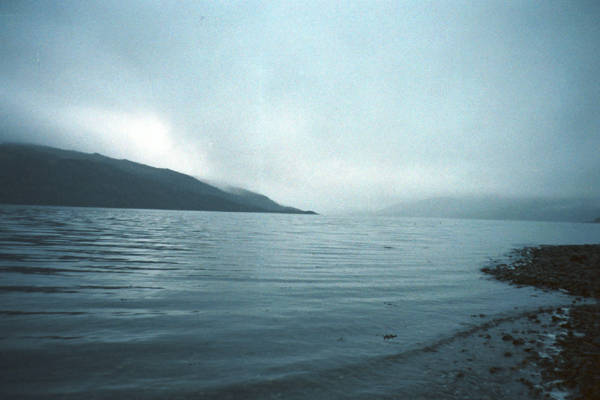
murky Scottish loch waters
with my key
to an open door
between us:

Thanks for coming, honey.
Love you so much.


Once dead
our connection
turns solid to water
exciting heat
with each new thing I learn.


Soon we will be
as close as I know how –
you crossing the threshold
of my dreams
to tell me in person
all the stones you’ve found.


Between us
we agree
not to throw pebbles
unless they can skip as easily
as lives off ice
across a frozen sea.

Monday, February 20, 2006

Heading toward you

In memorium, Lavena Fay Gober, February 17, 2006

Heading toward you
for our last goodbye
I don’t know what to say –
I never knew what to say to you
never knew who I was in your house –
non-favored daughter of your non-favored son.

You were always gnarled
surrounded by the blue of your veins –
your hands knotted around everything but my life.

I never thought that malformity would be me
but lately my feet
have taken the first steps
toward the shape of yours.

I have your feet
but never walked in your shoes.

And now, what am I to tell you,
as you turn from the grandmother
I hid from
to the ancestor I never knew –
who never understood or claimed me?

Your legacy of silent favoritism
a barrier I could never cross
built before I was born
and shored up with each of my mistakes
and years of my absent regrets.

Now the space between us flutters sheet-thin
and white like surrender.
Your breath and mine coming fast,
shallow, meeting somewhere past
where your stories end
and mine begin.

The overlap lies invisible
like our connection
like your influence
pulling me now to the right side of the bed
where you struggle for peace
and I reach for words to reach you.

Unable to hold your past
or our futures,
I will grasp your strong hands
soft if bony,
twisted like our familial love.

What will I say to you,
formidable, dismissive matriarch,
when my whole life
has been a silent, prolonged apology
buried in goodbye?

2/12/06

Sunday, February 19, 2006

A Planner's Thoughts During a Planning Meeting

I've forgotten
my chapstick.

I am sweaty
zitty
unpretty
fat
with goldfish
packed
around
golden
teeth.

Tuesday, February 14, 2006

2005 Bulwer-Lytton Fiction Contest

Reminded today to look for this year's start of a bad novel contest winner.

I wasn't impressed with the top prize, but I sure got a grin out of the winner for best Western:

As soon as Sherriff Russell heard Bradshaw say, "This town ain't big enough for the both of us," he inadvertantly visualized a tiny chalk-line circle with a town sign that said 'population 1,' and the two of them both trying to stand inside of it rather ineffectively, leaning this way and that, trying to keep their balance without stepping outside of the line, and that was why he was smiling when Bradshaw shot him."

Keriann Noble
Murray, UT

Update and Next Steps

Sorry to be silent. Got some bad news on Friday. Had hoped to defend on the 17th of Feb, but it looks like I've got some substantial changes to make, so now I'm looking at March 10. It's going to be fine. The changes will make the monster better for sure. Just tired. Hard to keep going. It's like mile 20 of the marathon. Come so far, but still have 6 miles to go. Ugh.


What's interesting me lately is that as I finish the thesis, I'm realizing how much this project mirrors an interest I've had for years and years -- since heading to school in Chicago, actually. Back then, I wanted to look at a particular intersection (no, I hadn't noticed that particular similarity until just now) north of Albuquerque. It's actually a freeway exit from I-25. If you head west, you pass through the town of Bernalillo, then Rio Rancho on your left, Santa Ana pueblo on your right. If you head east, you reach Placitas -- a quickly gentrifying area. The land immediately east of the freeway exit is U.S. Forest land. In other words, within a 2-mile radius, you've got jurisdictions that range from town to city to federal to Indian sovereign nation.

What do you do with the intersection? How do you mark such contested territory? Originally, my interest was in how all of these players could coordinate and plan together for the development of place.

Hmmm.... sound familiar?

And underneath that question is the more theoretical -- but more and more vital -- question the more I think about it: how do cultures assert themselves in space? In a multicultural world, how do you create multicultural spaces that value all, work for all, and make visible all?

This has been a slow surfacing realization. The more I realize I don't know, the more fascinated I get. I just headed back to the library and got 10 more books about ethnicity in space, particularly in cities, but really, this goes anywhere.

When you look at the most dangerous example in the world right now -- the deadly contest between Israel and Palestine -- the assumption seems to be either/or. Only one culture should exist in a space at one time. That's sovereignty, isn't it? It's the purest form of segregation, yet there is legitimacy to wanting and valuing the places where a group can exert power and control and be able to "regroup" and recharge its members and practice its own traditions.

bell hooks talks about the peace and rejuvenation of black folks in the South having their own communities where they don't constantly have to be in opposition to others. There is a necessity in speaking among ourselves, if only in certain places we control.

Yet the world is not big enough for us each to separate ourselves in this way, and global capitalism takes away this separatist option, anyway. And isn't there value in interacting with otherness, as well? Seeing ourselves anew because of outside perspectives? Don't we learn tolerance from having neighbors? Being neighbors?

I've always had an instinctual attraction to the concept of connection, but the more I learn, the more I see the need for us to explore the concept from all angles. Not just place but economics. Not just economics but linguistics. Communication. Architecture. Politics. International relations.

The New York Times featured an interview with linguist Deborah Tannen, first famous in the early 1990s for her book about the interaction of men and women called, You Just Don't Understand. She's just come out with a book about mothers and daughters.

When asked about the theme connecting all her books, here's what she has to say:

There's certainly a thread. My writing is about connecting ways of talking to human relationships. My purpose is to show that linguistics has something to offer in understanding and improving relationships.

There are many situations where problems arise between people because conversational styles vary with ethnic, regional, age, class and gender differences.

What can seem offensive to one group isn't to another. I've long believed that if you understand how conversational styles work, you can make adjustments in conversations to get what you want in your relationships.


What's true here of conversation is also true of place. The same considerations should be applied to place-making, whether approached through politics or planning or urban design or architecture.

So much to think about. So much to understand. So much work to be done before we can all live together and assert our culture in space and create shared places where we all belong.

Friday, February 03, 2006

Distraction

I'm so close that I'm already casting about for other things to focus on -- the classic diversion sabotage.

I have two more weekends of intensity, and it's all I can do to sit still and plug holes.

So I'm starting to see movies, starting to exercise, starting to see family and friends -- all when I should keep my blinders on and just FINISH.

I'm irritable and grumpy and soooooooooooooooo in avoidance mode that any reminder makes me irate. Yes, I know I should be working! Go AWAY!

And the news doesn't help. I want good news. Does anyone have good news? I feel isolated and vulnerable. And tired. And defenseless.

It all seems so difficult -- this life thing. This "making more of your life" thing. Can't it just be simple and beautiful and easy? When does that happen?

I need time off or a trip or ... okay. I just need to finish. I know. I know! But dammit, I'm sick of the whole thing. Why do I have to make everything so hard?

Friday, January 20, 2006

Digging in the Past

Paseo del Vulcan and the Double Eagle Airport

Between desert and sand
stripped down to mesa dust
we lie plane bathing
droning our sins in silence
erupting from sacred mountains
of long-dead fire.
from Bill Hocker, photographer
Him clouded uncertainty
clad in perfection
reserved for the shallow or lost
me pulsated yearning
like ants marching across Mexican weave
toward home.

The two of us salt-lick borders
where skin to skin our touch buzzes
frequency unmapped
connection unchartered
but richless
destined to fly away home.

He says you will burn.
I say brown is better.
We shade ourselves
with all we cannot say
fan ourselves with the flame
of our burning-out love.

2003

Albuquerque March 17

Albuquerque, March 17, 2003

By midnight
the streets were clear and quiet
rain softly drumming on tear-gas canisters
tapping on placards now wilting in the bushes
dissolving horseshit piled up in the streets.

The echo of flashing lights
remained glowing in the puddles
but the sirens now warn of the coming new order
in other corners of the city
to other crooks for other crimes.

One barrette lay open and glistening
in the intersection
between opposite lanes of traffic
at the base of a light
now free to turn green.

She will ask for it at police custody
her release the only thing they can hand her
in the absence of peace
apologies not yet forced from the mayor
by the headlines

her arrest still signaling
just their job
just another protest
just one more voice
shoved face-down to asphalt and rain.

Thursday, January 19, 2006

Lobocraspis griseifu

Lobocraspis griseifusa

This is the tiny moth who lives on tears,
who drinks like a deer at the gleaming pool
at the edge of the sleeper’s eye, the touch
of its mouth as light as a cloud’s reflection.

In your dream, a moonlight figure appears
at your bedside and touches your face.
He asks if he might share the poor bread
of your sorrow.  You show him the table.

The two of you talk long into the night,
but by morning the words are forgotten.
You awaken serene, in a sunny room,
rubbing the dust of his wings from your eyes.

-- Ted Kooser, Delights & Shadows

Tuesday, January 17, 2006

Close but not close ENOUGH.

I'm exhausted.

Finished one 40 page chapter, and it's all I can do to breathe!

But I have to turn around and write another one Saturday! Argh. Not sure I have it in me, but I don't know that I have it in me to stretch this out any more than it already has, either.

Rock. Me. Hard Place.

How did Odysseus get out of that one again? Trickery? Perseverance? Or did Athena sweep in with the wisdom he needed to change the situation to his advantage?

Like I said. Exhausted.

The good news is that it's 4/5 done. That's 80%. The bad news is that it will take considerable effort to finish the last 20%.

In the meantime, life is GOOD. Friends GOOD. Feeling balanced and adult and pretty damn happy. I'm working hard, so that's half the battle where I'm concerned. Too much free time, and I spiral into life-thoughts and hence, depression.

So looking forward to exercise! And friends! I can feel myself itching for social time with people I haven't seen in over a year. So bad.

Soon enough.

Soon. Enough.

Back into the breach, dear fellows. Pray for me.

Friday, January 13, 2006

Favorite NY Views


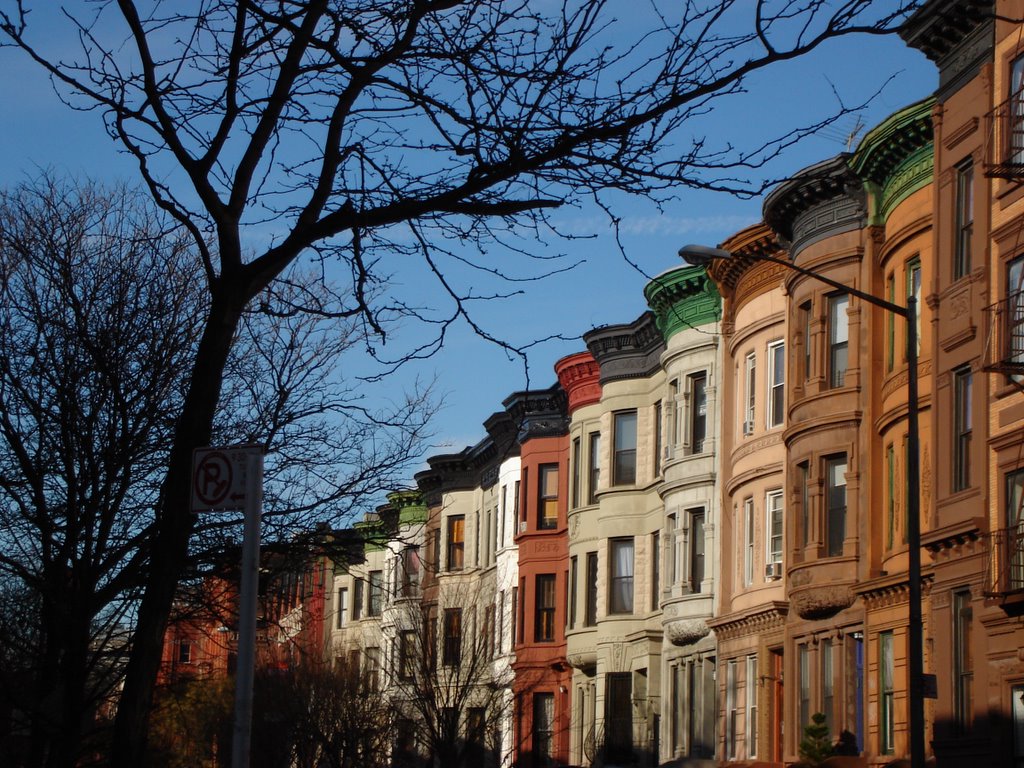
Roofline in Harlem.

Check out the reflection in the windows, not to mention the sexy fire escapes. My god! So beautiful...

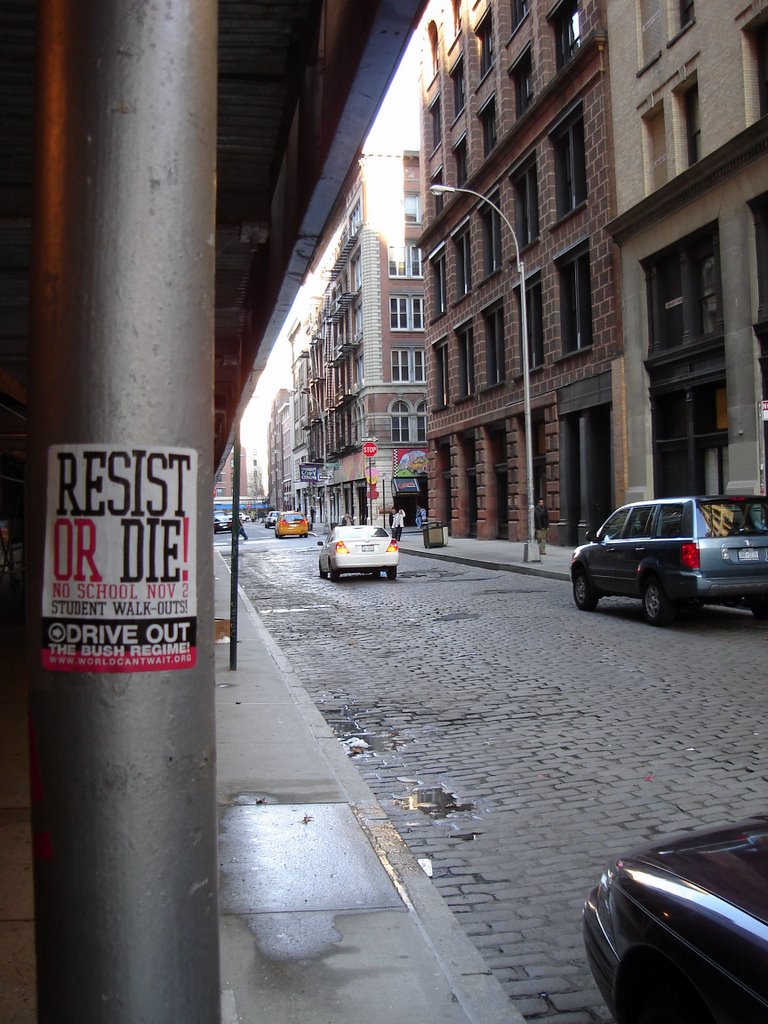
Adorning a post below the famous shirtwaist factory building, site of a historic turning point in the labor movement after the death of 141 women when a fire broke out. The building is now owned by NYU, where students now learn to be activists!

Favorite Brooklyn Views

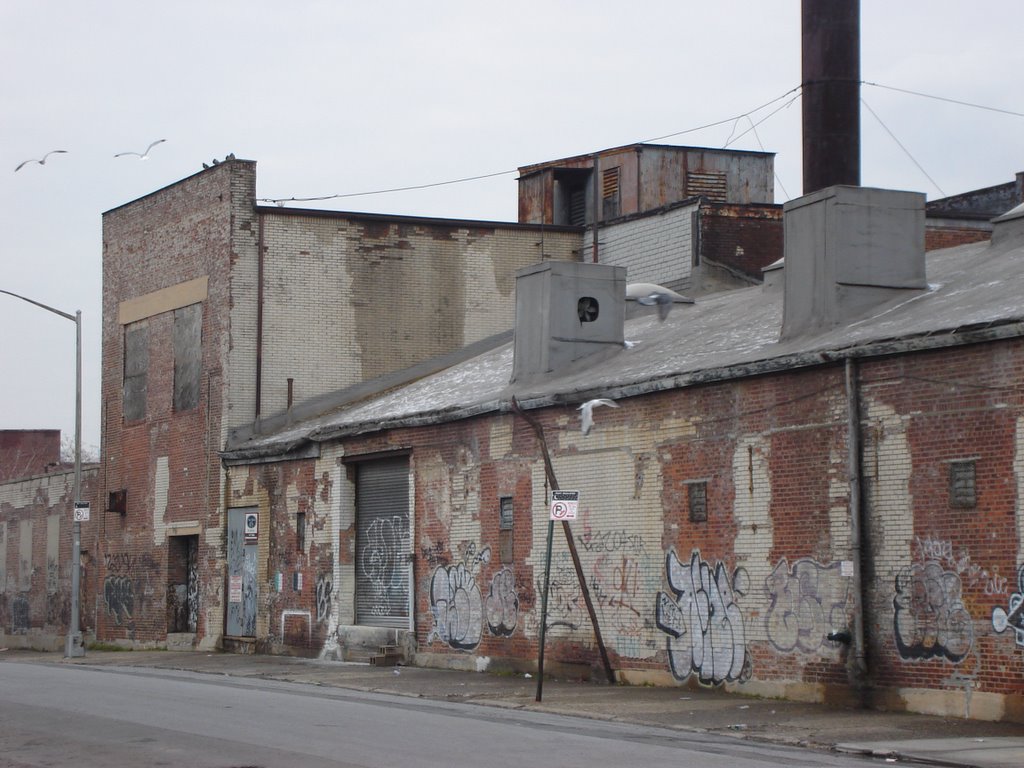
Loved the graffiti. Check out the uzi!

Industrial aesthic. Ooo...

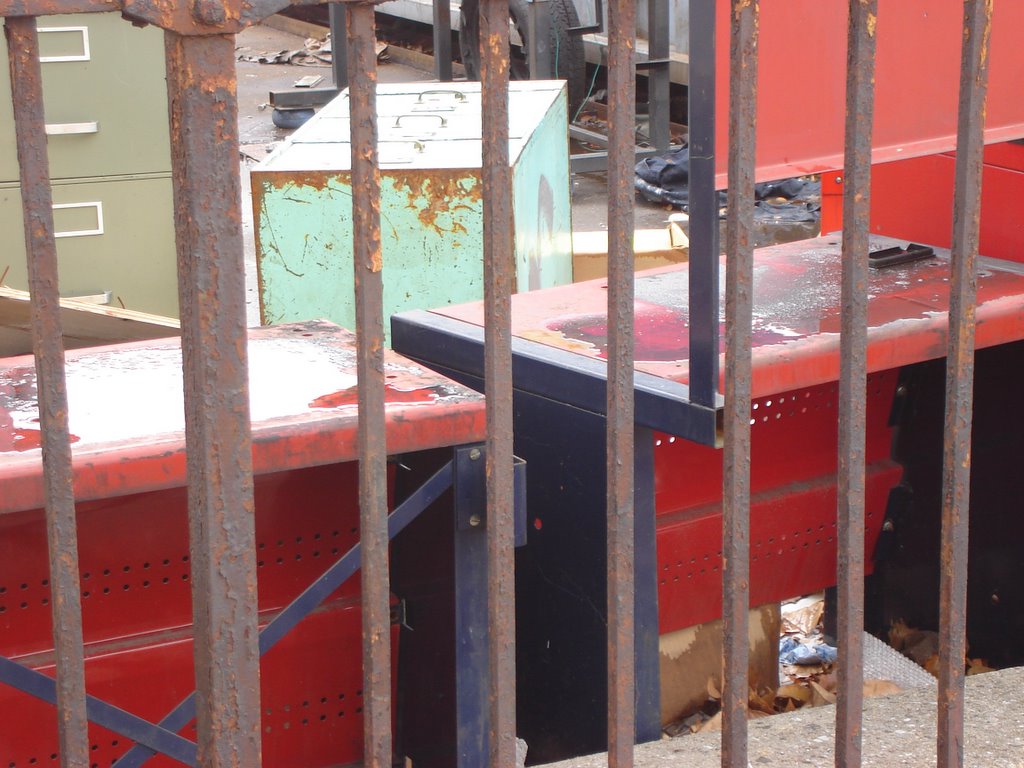
Reminds me of the Santa Fe shot. Industrial detritus. Mmmm...

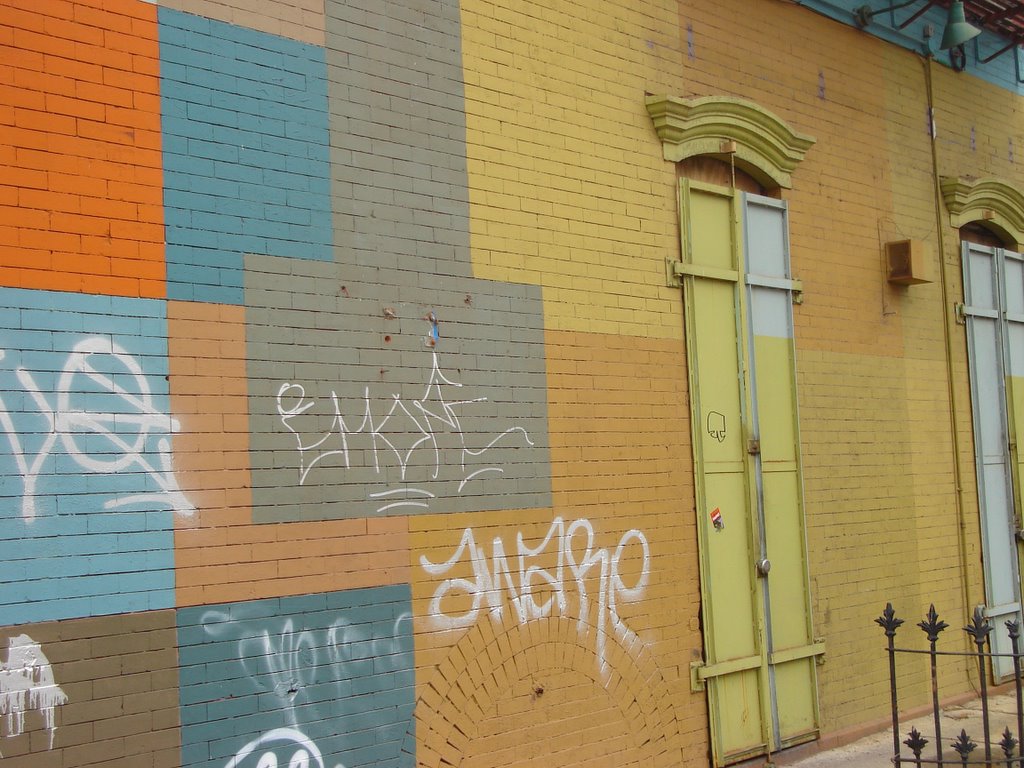
Creative housepainting. With graphiti. Yes!

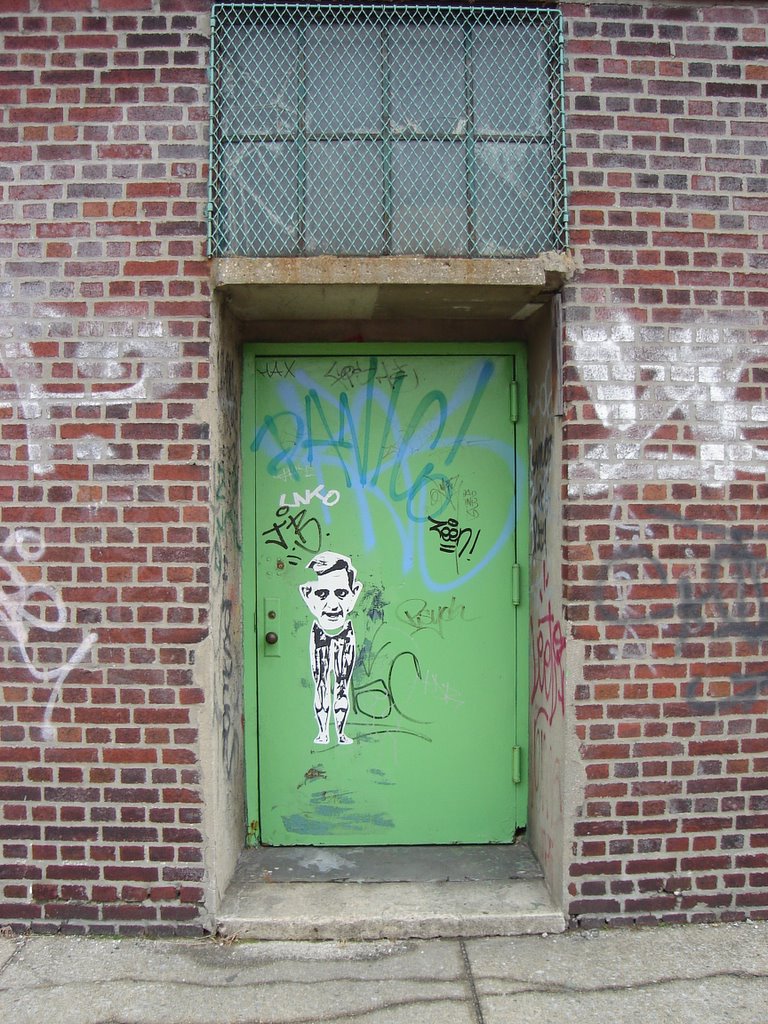
The door to the Hitchhiker's Galaxy. This time...PANIC!

Thursday, January 12, 2006

Venus de Milo

Upwards of steam
I breathe in silence
breathe out anger
muscles hardening to stone
one by one.

I am turning into Venus
arms lopped above the elbow.
You wouldn’t know it but
I’m reaching for you –
both of you.

Lover of my dark places
and hardened faces
Hermes guide back
into my hell-cave childhood,
your looming height
guards my secrets,
winged feet
prickster pranks
flank him on my other side.

Lover-to-be of my still-to-bes
domestic god of the hearth,
cooking-stove heat of rice simmering to a boil,
feed me a grain at a time
until I am full
from your hand,
belly distended
from our slow-swelling love.

June 2004

Friday, January 06, 2006

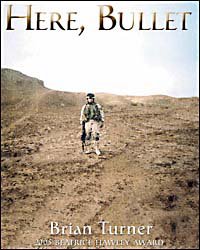
Brian Turner -- Asbah


From NPR: An American soldier in Iraq writes a book of haunting poems, Here, Bullet.


Ashbah

  • Brian Turner reads "Ashbah"

  • The ghosts of American soldiers
    wander the streets of Balad by night,
    unsure of their way home, exhausted,
    the desert wind blowing trash
    down the narrow alleys as a voice
    sounds from the minaret, a soulfull call
    reminding them how alone they are,
    how lost. And the Iraqi dead,
    they watch in silence from rooftops
    as date palms line the shore in silhouette,
    leaning toward Mecca when the dawn wind blows.

Wednesday, January 04, 2006

Baudelaire -- The Eyes of the Poor

From Paris Spleen, 1869, translated by  Louise Varèse

(Haussman was actively redoing the now-famous Paris boulevards, which Baudelaire references below. Baudelaire popularized the image of the flaneur -- the casual, removed observer who sees and strolls to be seen in urban spaces.)

Ah! So you would like to know why I hate you today? It will certainly be harder for you to understand than for me to explain, for you are, I believe, the most perfect example of feminine impermeability that exists.

We had spent a long day together which to me had seemed short. We had duly promised each other that all our thoughts should be shared in common, and that our two souls henceforth be but one -- a dream which, after all, has nothing original about it except that, although dreamed by every man on earth, it has been realized by none.

That evening, a little tired, you wanted to sit down in front of a new café forming the corner of a new boulevard still littered with rubbish but that already displayed proudly its unfinished splendors. The café was dazzling. Even the gas burned with all the ardor of a debut, and lighted with all its might the blinding whiteness of the walls, the expanse of mirrors, the gold cornices and moldings, fat-cheeked pages dragged along by hounds on leash, laughing ladies with falcons on their writs, nymphs and goddesses bearing on their heads piles of fruits, pates and game, Hebes and Ganymedes holding out little amphoras of syrups or parti-colored ices; all history and all mythology pandering to gluttony.

On the street directly in front of us, a worthy man of about forty, with tired face and greying beard, was standing holding a small boy by the hand and carrying on his arm another little thing, still too weak to walk. He was playing nurse-maid, taking the children for an evening stroll. They were in rags. The three faces were extraordinarily serious, and those six eyes stared fixedly at the new café with admiration, equal in degree but differing in kind according to their ages.

The eyes of the father said: "How beautiful it is! How beautiful it is! All the gold of the poor world must have found its way onto those walls." The eyes of the little boy: "How beautiful it is! How beautiful it is! But it is a house where only people who are not like us can go." As for the baby, he was much too fascinated to express anything but joy -- utterly stupid and profound.

Song writers say that pleasure ennobles the soul and softens the heart. The song was right that evening as far as I was concerned. Not only was I touched by this family of eyes but I was even a little ashamed of our glasses and decanters, too big for our thirst. I turned my eyes to look into yours, dear love, to read my thoughts in them; and as I plunged my eyes into your eyes, so beautiful and curiously soft, into those green eyes, home of Caprice and governed by the Moon, you said: "Those people are insufferable with their great saucer eyes. Can't you tell the proprietor to send them away?"

So you see how difficult it is to understand one another, my dear angel, how incommunicable thought is, even between two people in love.

Thursday, December 29, 2005

Life Testing

Man, it just doesn't get easier. I'm struggling to stay visible, but the sheer audacity of life has me fading to grey.


Here in NYC on vacation -- supposedly vacation. From my life, from my thesis, from my self, maybe.

And it's all here waiting for me. Now, I admit, I may have helped this a bit by arranging to stay with my high school boyfriend for the duration of the trip. So it's been all about -- how was I then and how am I now and what more do I know? He's exactly the same and says I'm exactly the same, and like that -- poof -- any work either of us has done in the past 10 years is reduced to rubble. To so much talk. Am I really who I was at 15? And if so, and I like who I am for the most part, isn't that a good thing that I've been a person I vaguely like for my whole life? Doesn't it mean I've been working pretty fucking hard for an illusion of progress? Doesn't that mean it's time to let go and accept more than I fight to change?

And the other mess was waiting for me, here, too. A certain someone who fits old pattern who's here to test my resolve to live fully and refuse to be treated less than I demand. Deserve. One playing into the other...

And he shows up. Ex-girlfriend in tow. In the town of 7 million where I just happen to be. The nightclub I just happened to have made plans to visit. The precise entertainment I went to enjoy.

And this is subtle? This is life's gentle lesson?

And part of me cares. Part of me wants to care more. Part less. A whole lot of me is just watching.

And it's being in the city of nameless souls. It's being a tourist not a person. Writing other people's words and lists of artists I like instead of the words that come from me.

It's reacting to others instead of knowing myself. As usual.

Watching myself try to relate to others. See their needs. Manipulate to meet my own. Not speak them out loud.

Gabe says he feels/felt there was so much of me I just never shared. That made him sad. Made him feel inadequate a lot of the time. Something he struggles with anyway. What a pair.

And I wonder how much that is true of me. My own fear that asking for anything will make him leave because I'm not worth giving anything to. Better not to be a burden. Do it myself or let go of the need. Or resent. Hmmm.... who does that sound like? What pattern did I learn?

I'm wondering whether to send my father the Daddy's Dealing poem for fathers' day. Jayson called on Christmas morning from the airport. I talked to all three of them in a record 2:21. Anne says she has my birthday present. Dad says he wants to see me. Jayson just says, I love you. The rest is a conversation a foreign country away.

Strange to feel so grounded and so out-of-body all at once. Maybe this is grace? Paralysis? Transition? Hard to say, but I hear the echoes of words to come barreling down the mind shaft. Soon, my hands will be black with coal dust. Me, the miner's daughter.

Communing with Balzac

Self-portrait of Mikaela in NYC's MoMA with the famous Rodin piece. I guess you could call it, a Girl and her Balz.

Thursday, December 22, 2005

And now, back to your regularly scheduled program

So after the non-stop panic for a week to write write write, the holidays are finally taking over.

Last night was a party at Mark Rudd's South Valley haven. So many great people there! Had a wonderful conversation with Demetria Martinez about Cornell West and bell hooks, as well as the happy news that her most recent book -- Confessions of a Berlitz-Tape Chicana -- went for emergency second printing because it's been flying off the shelves!

Had a great chat with State Senator Dede Feldman, whose new blog is reviewed on Duke City Fix. We talked about her start as a journalist and her philosophy that all politics is communication, which is troubling because so many politicians are so bad at it!

Had lovely talks, too, with a soon-to-be-ex-employee of Quarters who has recently decided that he, too, like his parents, is a socialist. His girlfriend works in public health, and we had a conversation about how health care delivery in NM compares to socialist countries in Europe.

Just a whole party of thinking, creative people! What could be better? I love feeling the strong progressive community in the Q.

Monday, December 19, 2005

Tonight's Work - - Lynch Analysis

Lynch Analysis of Place Elements

When Lynch performed analysis on places for his book Image in the City, his method was to gather cognitive maps drawn by city residents that were then compiled and analyzed. The underlying question of one of the image people have of the city, not necessarily one of identity or how well the city works for them, or how well it works in general, for that matter.

The question here goes beyond the image residents have of this place toward the question of what to do to make it better. While residents had four separate categories of interventions they would like, this analysis proceeds through the screen of identity, which was one strategy identified toward political and physical improvements to place. As such, the results we look for through the Lynch analysis supersede his original purpose, necessitating an adjustment to the analysis itself. This analysis will attempt to look at the physical elements drawn or described in the maps to get a sense of how this place works for its residents and other participants at Workshop I.

The seminal Lynch elements consist of district, path, edge, and landmark.

District

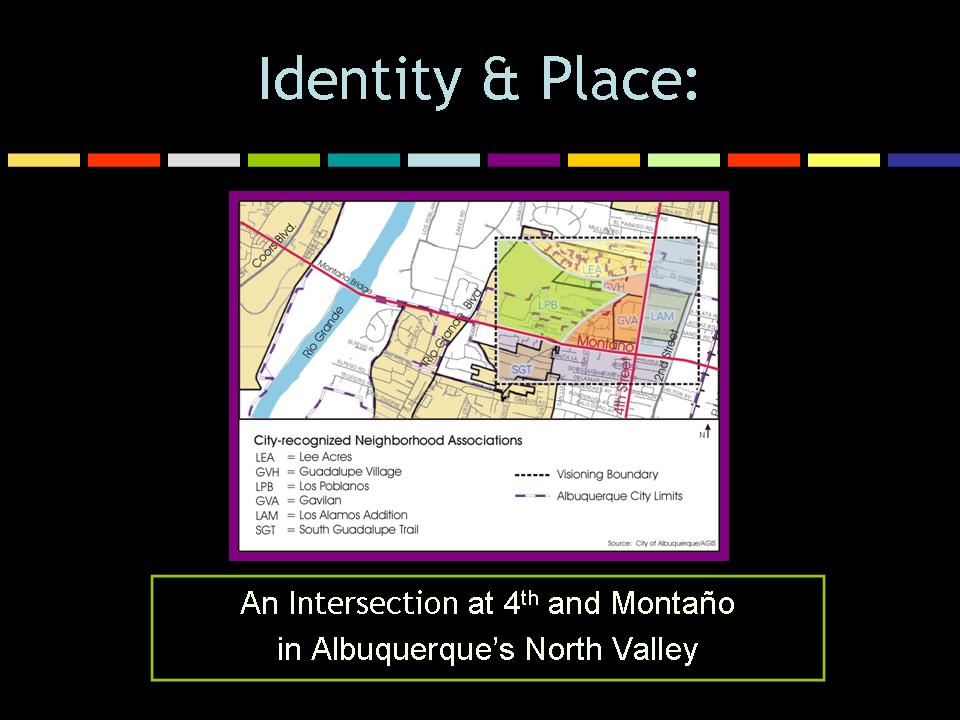
In the sense of district, this area is surrounded by districts that stop at its edges. Los Ranchos to the north, the Westside to the west, Downtown to the south, perhaps the shopping center beginning to take shape on the west side of I-25 and Montaño. The area as defined by the visioning boundaries does not operate as a district in the sense of holding together or being self-sufficient, despite several residents describing the Village or small-town feel of their community. These comments are not associated with any boundaries but rather describe a lifestyle that incorporates open space, trails, and agricultural lands on as daily experiences.

In a smaller sense than Lynch normally used in defining a district, the area to the west of 4th Street, bounded by Solar to the north, Montaño to the south and Rio Grande to the west, which includes Los Poblanos as its figurative center, has some weight as a conceptual district. The roads that form the boundaries operate as strong edges due to their poor permeability for any mode of transportation. Guadalupe Trail is the main path through this district for cars, bikes, and pedestrians, with Harwood Lateral an important path for pedestrians and bikes. Guadalupe Village provides important services and shopping opportunities. St. Michaels is an important community center; even as it turns its back on the neighborhood to front Montaño, it is accessible by foot from the nearby residences.

Path

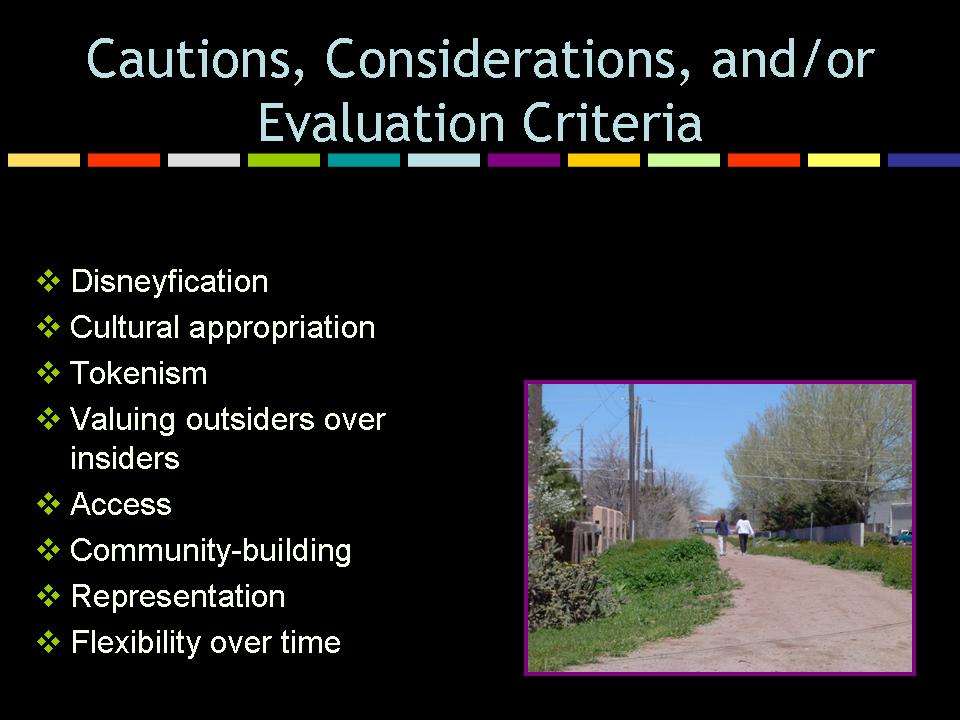
Paths by foot and bicycle are well-defined by acequia trails, which also serve as an important setting for informal interaction with neighbors. In order of importance as measured by times mentioned during Workshop I, the acequias are as follows: Gallegos Lateral, Harwood Lateral, Gallegos Lateral/Alameda Drain, Guadalupe Trail, and Hackman Lateral. Gallegos is a main east-west path. Harwood and Guadalupe Trail are both north-south routes that could connect residents throughout the area if the crossing over Montaño could be made safe. Gallegos Lateral/Alameda Drain could provide a regional connection with Los Ranchos to the north and Downtown to the south for commuting bikers if the trail were to be improved. Hackman Lateral could improve neighborhood access to Los Poblanos, which right now is only accessible via Montaño to the south and through a private development on the east. These paths are well-used now but could be integral to area connectivity if they were improved.

Interior residential streets do not work well as paths because they are not connective. They tend to work as dead-end subdivision spurs to connect houses to main arterials for cars. They do not work well to connect residential to residential streets. Cars move quickly on them, undermining their use by children or non-car traffic due to safety concerns. Solar and Gene Avenues are important east-west streets that connect neighborhoods north of Montaño. Douglas MacArthur performs the same function for neighborhoods south of Montaño. East-west streets west of 4th Street are not interconnected. They provide singular access for residents living on that street, which deadend at 2nd Street.

4th Street is the dominant path for all residents, as it is the main access to/from the area and to/from all residential neighborhoods. Montaño does not emerge as a path in this analysis, since residents do not travel on Montaño west of 4th Street, and traffic congestion minimizes its usefulness east of 4th Street.

Edge

Montaño does emerge strongly as an edge in this area, separating neighborhoods to the north from neighborhoods to the south. Pedestrians and bicycles cannot cross safely, which was mentioned again and again as residents decried the lack of access at Guadalupe Trail or the Harwood Lateral. 4th and Montaño is too busy and poorly designed for safe crossing by any mode of traffic. Only one street south of Montaño empties onto Montaño – 9th Street, except for gated communities that ONLY empty to Montaño but turn their backs on neighborhoods to their south. To the north, neighborhoods dead-end at Montaño. There is a park at the termination of Guadalupe Trail at Montaño that residents called “useless.” It consists of little more than xeriscape median and a sign.

2nd Street is a strong conceptual edge to the east, particularly for Los Alamos addition residents, whose residential streets dead-end at the Gallegos Lateral/Alameda Drain, directly between them and 2nd Street. The industrial and highway-scale character of 2nd Street contrasts sharply with both 4th Street and Montaño. Despite 4th Street’s shortcomings, it is still a local street, lined with small-scale, local-serving businesses, and it remains four lanes. Montaño, even post re-striping to four lanes, remains a boulevard. Its distinguishing characteristics are xeriscape landscaping, well-spaced businesses on large lots with large set-backs. 2nd Street, at four lanes with generous turn lanes and shoulders, hosts large-scale businesses that are usually gated and stand self-contained and imposing with vacant space in-between. The Gallegos Lateral/Alameda Drain precludes development on the west side of 2nd Street, but the absence of trees, path, or street furniture leaves this potential place-making characteristic simply a well-mowed ditch (not in the good sense but rather just a hole in the ground).

There is no strong sense of an edge to the north. Lee Acres is a distinctive neighborhood, whose character of large lots and non-vernacular architecture sets it apart and therefore may serve as an edge to some residents. The next large shopping center north, where _____ terminates, may function as the next conceptual boundary.

There is no edge to the south, as the (strip-retail and chain restaurants) character of 4th Street continues toward downtown, and residential streets replicate themselves as they make their way toward Griego, where the grid begins to reassert itself in residential streets.

Landmarks

Landmarks are sparse and not universally accepted/perceived. Guadalupe Plaza, with its large sign and large-scale buildings, including the important shopping destination of Smiths and entertainment destination Blockbuster, works as a landmark for many residents. Sadies is on most community maps and may operate as an important place for informal community interaction. Other popular businesses include the Fruit Basket, Luigis, Ramon’s, Sophie’s, Dion’s, Walgreens, and the Bowling Alley.

Los Poblanos is a landmark, but it has limited visibility to all but those living nearby because of its location insulated by residential neighborhoods. It can be seen from Montaño, but residents rarely travel on Montaño, as stated above. Still, community events such as the corn maize and the existence of the community farm give residents reasons to go there.

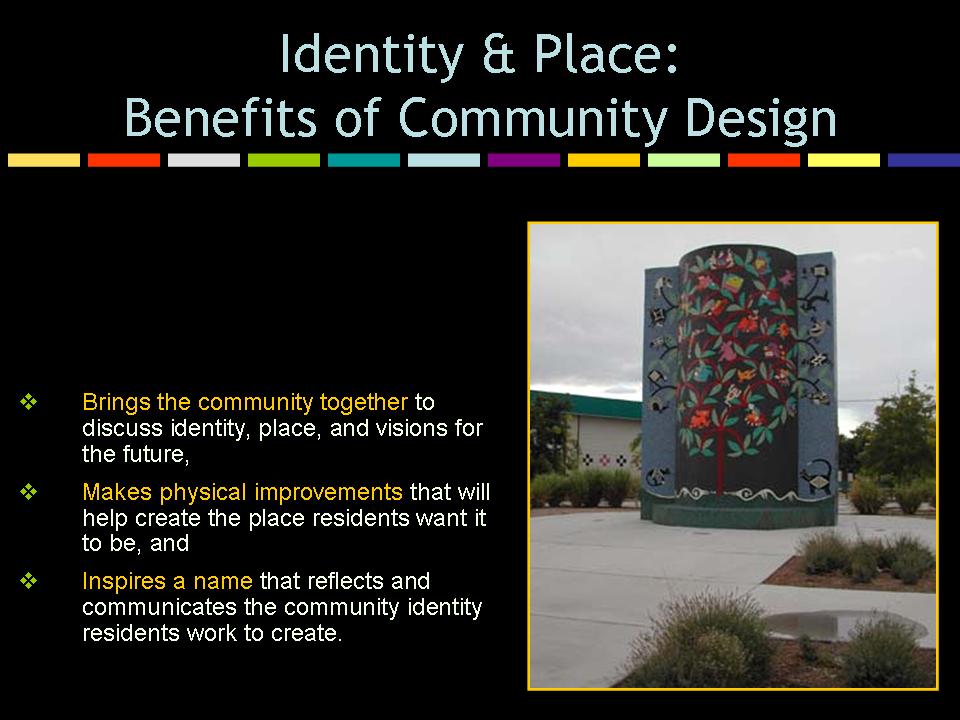
The mosaic sculpture – the Tree of Life – on the southeast corner of 4th and Montaño was mentioned several times by residents, although they also described it being overshadowed by the new carwash immediately to the east. A nearby “Tile House” on one of the Los Alamos Addition streets was also described as a landmark, and together, these two landmarks establish a character theme for mosaic tile for some residents.

Perhaps the most important landmark is the intersection of 4th and Montaño itself. When asked where residents live, it is often this intersection that gives the identifying reference point. Its scale and integral-ness to the community cements its status as a landmark, however hated.

Grecian Park is an important landmark for some residents living west of 4th Street and north of Montaño.

Los Alamos Addition, with its idyllic, tree-lined streets, functions as a landmark for some residents who know it’s there. Driving on 4th Street, it’s easy to pass by without glimpsing these charming streets at all.

The Montaño Bridge itself is a landmark, although it can’t really be described as part of this area. Despite its disastrous effect on the area, one resident still described the bridge itself as “lovely.”


Alvarado Elementary School near Los Poblanos is a landmark for several residents, as is Douglas MacArthur Elementary School south of Montaño. These are really the only public institutions in the area, separate from churches, and this status might elevate their importance as not only landmarks or schools but the only presence of City institutions.