Sunday, November 15, 2020

Song - Japanese Bowl - Peter Mayer


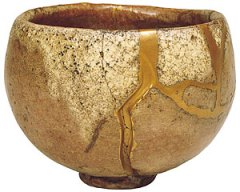
I’m like one of those Japanese bowls
That were made long ago
I have some cracks in me
They have been filled with gold

That’s what they used back then
04_03
When they had a bowl to mend
It did not hide the cracks
It made them shine instead

So now every old scar shows
from every time I broke
And anyone’s eyes can see
I’m not what I used to be

But in a collector’s mind
All of these jagged lines
Make me more beautiful
And worth a higher price

I’m like one of those Japanese bowls
I was made long ago
I have some cracks you can see
See how they shine of gold.

Quote by Australian activist Christine Caine

 "Sometimes when you're in a dark place, you think you've been buried, but actually, you've been planted."


Wintered Over (Poem) by Lisa Breger


Water carries sunlight along a narrow twisting stream;

sunlight glitters on the water’s back

light among dark trees.

I watch a hawk in the distance glide the thermals


rise and circle the open space over Lake Cochituate.

Soon it will be lilac season

among other kindnesses.

To have weathered this harsh winter


didn’t take courage or strength

though the lilacs are hardy

and the season brings forth.

How can I have nothing to say about this;


a survivor always has a story.

Maybe you just keep on living

even when the odds are against you.

A nurse brings a saucer of milk to your lips


and the cat in you,

how many lives now,

takes a swallow.

Then, you lift a hand and take her hand,


another sip,

and lift yourself up

which is what I remember.

Transplanted stem cells find their way back to the marrow.


I was neither strong nor brave.

I stayed in bed and looked out the window.

Some days the old oaks across the way swayed in the wind other

days: stillness and birds.


I don’t know why I made it.

Don’t we all have a fierce desire

to see a hummingbird

drink from the trumpet vine?


Saturday, November 14, 2020

Poem - Heavy - Mary Oliver


That time
I thought I could not
go any closer to grief
without dying

I went closer,
and I did not die.
Surely God
had his hand in this,

as well as friends.
Still, I was bent,
and my laughter,
as the poet said,

was nowhere to be found.
Then said my friend Daniel,
(brave even among lions),
“It’s not the weight you carry

but how you carry it –
books, bricks, grief –
it’s all in the way
you embrace it, balance it, carry it

when you cannot, and would not,
put it down.”
So I went practicing.
Have you noticed?

Have you heard
the laughter
that comes, now and again,
out of my startled mouth?

How I linger
to admire, admire, admire
the things of this world
that are kind, and maybe

also troubled –
roses in the wind,
the sea geese on the steep waves,
a love
to which there is no reply?

Sunday, November 08, 2020

Resilient - Rising Appalachia (song)


Poem - from "A Brave and Startling Truth" - Maya Angelou


We, this people, on this small and drifting planet
Whose hands can strike with such abandon
That in a twinkling, life is sapped from the living
Yet those same hands can touch with such healing, irresistible tenderness
That the haughty neck is happy to bow
And the proud back is glad to bend
Out of such chaos, of such contradiction
We learn that we are neither devils nor divines

Poem - MY GOD, IT’S FULL OF STARS (PART 5) - Tracy K. Smith


When my father worked on the Hubble Telescope, he said
They operated like surgeons: scrubbed and sheathed
In papery green, the room a clean cold, a bright white.

He’d read Larry Niven at home, and drink scotch on the rocks,
His eyes exhausted and pink. These were the Raegan years,
When we lived with our finger on The Button and struggled

To view our enemies as children. My father spent whole seasons
Bowing before the oracle-eye, hungry for what it would find.
His face lit up whenever anyone asked, and his arms would rise

As if he were weightless, perfectly at ease in the never-ending
Night of space. On the ground, we tied postcards to balloons
For peace. Prince Charles married Lady Di. Rock Hudson died.

We learned new words for things. The decade changed.

The first few pictures came back blurred, and I felt ashamed
For all the cheerful engineers, my father and his tribe. The second time,
The optics jibed. We saw to the edge of all there is —

So brutal and alive it seemed to comprehend us back.

Poem - ODE TO BUTTONING AND UNBUTTONING MY SHIRT - Ross Gay


No one knew or at least
I didn’t know
they knew
what the thin disks
threaded here
on my shirt
might give me
in terms of joy
this is not something to be taken lightly
the gift
of buttoning one’s shirt
slowly
top to bottom
or bottom
to top or sometimes
the buttons
will be on the other
side and
I am a woman
that morning
slipping the glass
through its slot
I tread
differently that day
or some of it
anyway
my conversations
are different
and the car bomb slicing the air
and the people in it
for a quarter mile
and the honeybee’s
legs furred with pollen
mean another
thing to me
than on the other days
which too have
been drizzled in this
simplest of joys
in this world
of spaceships and subatomic
this and that
two maybe three
times a day
some days
I have the distinct pleasure
of slowly untethering
the one side
from the other
which is like unbuckling
a stack of vertebrae
with delicacy
for I must only use
the tips
of my fingers
with which I will
one day close
my mother’s eyes
this is as delicate
as we can be
in this life
practicing
like this
giving the raft of our hands
to the clumsy spider
and blowing soft until she
lifts her damp heft and
crawls off
we practice like this
pushing the seed into the earth
like this first
in the morning
then at night
we practice
sliding the bones home.

Anger - David Whyte

 Loving Brainpicking today!

Poet and Philosopher David Whyte on Anger, Forgiveness, and What Maturity Really Means

ANGER is the deepest form of compassion, for another, for the world, for the self, for a life, for the body, for a family and for all our ideals, all vulnerable and all, possibly about to be hurt. Stripped of physical imprisonment and violent reaction, anger is the purest form of care, the internal living flame of anger always illuminates what we belong to, what we wish to protect and what we are willing to hazard ourselves for. What we usually call anger is only what is left of its essence when we are overwhelmed by its accompanying vulnerability, when it reaches the lost surface of our mind or our body’s incapacity to hold it, or when it touches the limits of our understanding. What we name as anger is actually only the incoherent physical incapacity to sustain this deep form of care in our outer daily life; the unwillingness to be large enough and generous enough to hold what we love helplessly in our bodies or our mind with the clarity and breadth of our whole being.

...

What we have named as anger on the surface is the violent outer response to our own inner powerlessness, a powerlessness connected to such a profound sense of rawness and care that it can find no proper outer body or identity or voice, or way of life to hold it. What we call anger is often simply the unwillingness to live the full measure of our fears or of our not knowing, in the face of our love for a wife, in the depth of our caring for a son, in our wanting the best, in the face of simply being alive and loving those with whom we live.

Our anger breaks to the surface most often through our feeling there is something profoundly wrong with this powerlessness and vulnerability… Anger in its pure state is the measure of the way we are implicated in the world and made vulnerable through love in all its specifics.
...

Anger truly felt at its center is the essential living flame of being fully alive and fully here; it is a quality to be followed to its source, to be prized, to be tended, and an invitation to finding a way to bring that source fully into the world through making the mind clearer and more generous, the heart more compassionate and the body larger and strong enough to hold it. What we call anger on the surface only serves to define its true underlying quality by being a complete but absolute mirror-opposite of its true internal essence.


...

To forgive is to put oneself in a larger gravitational field of experience than the one that first seemed to hurt us. We reimagine ourselves in the light of our maturity and we reimagine the past in the light of our new identity, we allow ourselves to be gifted by a story larger than the story that first hurt us and left us bereft.

Poem - The Weighing - Jane Hirschfield


So few grains of happiness
measured against all the dark
and still the scales balance.

The world asks of us
only the strength we have and we give it.
Then it asks more, and we give it.

Wednesday, November 04, 2020

Day after the 2020 Presidential Election in 2020

 What's the right metaphor? Oil and water. Knit and perl? We are made from the same cloth, yet in taking shape for one, we shape the other. We face opposite worlds and so come to opposite conclusions. America is just; America is just racist.

I want to ask each Trump voter, when you were alone in a voting booth made for you, and you went to cast your secret ballot, between you and the outcome you wanted, what was your vote FOR? What did you cast your vote AGAINST?  What did you fear would happen, is happening? What do you see that you want more of? More COVID deaths? More kids in cages? More lunatic rants via Twitter? More countries to see us and despair, form their own coalitions to save the globe? More emptying of the federal coffers into Trump golf properties?

When the pollster asked who you would vote for, why couldn't you bring yourself to say "Trump" out loud? Did you go to his rallies? Did you listen? What did you hear that you liked? That made you feel safe? That said, "this guy should lead our country for 4 more years!"

Lines from H.D.'s Eurydice

what was it you saw in my face?
the light of your own face,

the fire of your own presence?
....

So for your arrogance
and your ruthlessness
I have lost the earth
and the flowers of the earth,
and the live souls above the earth,
and you who passed across the light
and reached
ruthless;

you who have your own light,
who are to yourself a presence,
who need no presence;

yet for all your arrogance
and your glance,
I tell you this:

such loss is no loss,
such terror, such coils and strands and pitfalls
of blackness,
such terror
is no loss;

hell is no worse than your earth
above the earth,
hell is no worse,
no, nor your flowers
nor your veins of light
nor your presence,
a loss;

my hell is no worse than yours
though you pass among the flowers and speak
with the spirits above earth.

Against the black
I have more fervour
than you in all the splendour of that place,
against the blackness
and the stark grey
I have more light;

and the flowers,
if I should tell you,
you would turn from your own fit paths
toward hell,
turn again and glance back
and I would sink into a place
even more terrible than this.

At least I have the flowers of myself,
and my thoughts, no god
can take that;
I have the fervour of myself for a presence
and my own spirit for light;

and my spirit with its loss
knows this;
though small against the black,
small against the formless rocks,
hell must break before I am lost;

before I am lost,
hell must open like a red rose
for the dead to pass.


And Robinson Jeffers - The Answer


 What is there to hold onto when half of us won't admit what we want or face the consequences of our vote? 

I am reading Isabel Wilkerson's Caste, and the research linking Nazi Germany during the Third Reich with their legal model - the Jim Crow era South is truly terrifying. How did Germany recover when so many participated and so many let it happen? There will be no Nuremberg trials here. No calling to account. No fleeing of war criminals to Venezuela. Trump will make and lose another $400 million. And Tweet the whole time about hate and unfair treatment - of him and his cronies. He'll be lionized as the worst-treated president of time. Poor him. 

And we're left to ... what? Try to cobble together a coalition of the not-quite-terrible. The turnable. The ones who will only admit it was about the economy but say they never liked what Trump said in his worst moments. 

I hope we ask more questions of the people who supported or propped up or voted for or just held their nose for this despicable, petty despot. I want to understand. I'm listening for common ground. For hope. For shared values. For shared fears, even. For something that resembles a thought that I might have on a tough day or after a few dozen tough years. 

These are Hillbilly Ellegy people. Saying that no one else should get bootstraps until they've made it out of the coalmine. I don't want to join them there. Or leave them there. Or leave anyone there. 

The canary's dead. Let's all make our way into the light. It will take some time to get us all up in the lift. We'll take turns, and you can send water and food down with each return trip. Let's sing together as we wait. Who knows this one? I'm gonna keep on moving forward...

Saturday, October 24, 2020

V'ahavta (poem) by Aurora Levins Morales


Full poem here.


Say these words when you lie down and when you rise up,
when you go out and when you return. In times of mourning
and in times of joy. ...
[R]ecite them in your sleep, here in the cruel shadow of empire:
Another world is possible.

Thus spoke the prophet Roque Dalton:
All together they have more death than we,
but all together, we have more life than they.

...So instead,

imagine winning. This is your sacred task.
This is your power. ...
Lean with all your being towards that day
when the poor of the world shake down a rain of good fortune
out of the heavy clouds, and justice rolls down like waters.

Defend the world in which we win as if it were your child.
It is your child.
Defend it as if it were your lover.
It is your lover.

...

Don’t waver. Don’t let despair sink its sharp teeth
Into the throat with which you sing. Escalate your dreams.
Make them burn so fiercely that you can follow them down
any dark alleyway of history and not lose your way.
...

Hold hands. Share water. Keep imagining.
So that we, and the children of our children’s children
may live

A Small Needful Fact (poem) by Ross Gay


Is that Eric Garner worked
for some time for the Parks and Rec.
Horticultural Department, which means,
perhaps, that with his very large hands,
perhaps, in all likelihood,
he put gently into the earth
some plants which, most likely,
some of them, in all likelihood,
continue to grow, continue
to do what such plants do, like house
and feed small and necessary creatures,
like being pleasant to touch and smell,
like converting sunlight
into food, like making it easier
for us to breathe.

Copyright © 2015 by Ross Gay. Reprinted from Split This Rock’s The Quarry: A Social Justice Poetry Database.

"this freedom, this liberty, this beautiful and terrible thing, needful to man as air"

Song - Keep on Moving Forward/Sigamos Adelante - Emma's Revolution


Sunday, October 18, 2020

Poem - The Sound of One Fork - Minnie Bruce Pratt


Through the window screen I can see an angle of grey roof
and the silence that spreads in the branches of the pecan tree
as the sun goes down. I am waiting for a lover. I am alone
in a solitude that vibrates like the cicada in hot midmorning,
that waits like the lobed sassafras leaf just before
its dark green turns into red, that waits
like the honeybee in the mouth of the purple lobelia.

While I wait, I can hear the random clink of one fork
against a plate. The woman next door is eating supper
alone. She is sixty, perhaps, and for many years
has eaten by herself the tomatoes, the corn
and okra that she grows in her backyard garden.
Her small metallic sound persists, as quiet almost
as the windless silence, persists like the steady
random click of a redbird cracking a few
more seeds before the sun gets too low.
She does not hurry, she does not linger.

Her younger neighbors think that she is lonely.
But I know what sufficiency she may possess.
I know what can be gathered from year to year,
gathered from what is near to hand, as I do
elderberries that bend in damp thickets by the road,
gathered and preserved, jars and jars shining
in rows of claret red, made at times with help,
a friend or a lover, but consumed long after,
long after they are gone and I sit
alone at the kitchen table.

And when I sit in the last heat of Sunday, afternoons
on the porch steps in the acid breath of the boxwoods,
I also know desolation. The week is over, the coming night
will not lift. I am exhausted from making each day.
My family, my children live in other states,
the women I love in other towns. I would rather be here
than with them in the old ways, but when all that’s left
of the sunset is the red reflection underneath the clouds,
when I get up and come in to fix supper,
in the darkened kitchen I am often lonely for them.

In the morning and the evening we are by ourselves,
the woman next door and I. Still, we persist.
I open the drawer to get out the silverware.
She goes to her garden to pull weeds and pick
the crookneck squash that turn yellow with late summer.
I walk down to the pond in the morning to watch
and wait for the blue heron who comes at first light
to feed on minnows that swim through her shadow in the water.
She stays until the day grows so bright
that she cannot endure it and leaves with her hunger unsatisfied.
She bows her wings and slowly lifts into flight,
grey and slate blue against a paler sky.
I know she will come back. I see the light create
a russet curve of land on the farther bank,
where the wild rice bends heavy and ripe
under the first blackbirds. I know
she will come back. I see the light curve
in the fall and rise of her wing.
Visitation (Poem) by Mark Doty

When I heard he had entered the harbor,
and circled the wharf for days,
I expected the worst: shallow water,

confusion, some accident to bring
the young humpback to grief.
Don't they depend on a compass

lodged in the salt-flooded folds
of the brain, some delicate
musical mechanism to navigate

their true course? How many ways,
in our century's late iron hours,
might we have led him to disaster?

That, in those days, was how
I'd come to see the world:
dark upon dark, any sense

of spirit an embattled flame
sparked against wind-driven rain
till pain snuffed it out. I thought,

This is what experience gives us ,
and I moved carefully through my life
while I waited. . . Enough,

it wasn't that way at all. The whale
—exuberant, proud maybe, playful,
like the early music of Beethoven—

cruised the footings for smelts
clustered near the pylons
in mercury flocks. He

(do I have the gender right?)
would negotiate the rusty hulls
of the Portuguese fishing boats

—Holy Infant, Little Marie—
with what could only be read
as pleasure, coming close

then diving, trailing on the surface
big spreading circles
until he'd breach, thrilling us

with the release of pressured breath,
and the bulk of his sleek young head
—a wet black leather sofa

already barnacled with ghostly lice—
and his elegant and unlikely mouth,
and the marvelous afterthought of the flukes,

and the way his broad flippers
resembled a pair of clownish gloves
or puppet hands, looming greenish white

beneath the bay's clouded sheen.
When he had consumed his pleasure
of the shimmering swarm, his pleasure, perhaps,

in his own admired performance,
he swam out the harbor mouth,
into the Atlantic. And though grief

has seemed to me itself a dim,
salt suspension in which I've moved,
blind thing, day by day,

through the wreckage, barely aware
of what I stumbled toward, even I
couldn't help but look

at the way this immense figure
graces the dark medium,
and shines so: heaviness

which is no burden to itself.
What did you think, that joy
was some slight thing?

Saturday, October 17, 2020

Poem - Blessings for the Beginning - Kari Kopnick


The things to do have been done, well, for the most part.
The people we need are in place, almost.
We are ready, or as ready as we will be.

Bless this most perfectly imperfect beginning.
May we find the right people to do the right things as we go.
May we discover that what we needed was right here all along.
And may we remember to stop and marvel at the magic of each moment as it floats by.

Wednesday, October 07, 2020

 Weird thing. 

My family traveled to Umeå, Sweden a year ago for a memorial for my husband's mother.

The kids, then 10 and 6, did great. But every time we passed McDonald's the call of "home" was almost undeniable.

We ate there for the first time in Stockholm, and I was thrilled to see a "Chicken and Hummus Salad" on the menu, as well as sparking water! I ate better at a McDonald's than ever before or ever since.


The salad features hummus and grilled chicken alongside black rice, edamame, and green and red cabbage. To finish off the dish, the salad is drizzled with a sweet and tangy chili dressing.

The next time the kids wanted to hit Mickey D's, they got a big YES from me.

Little did I know that I should have said yes even more than I did. I figured Sweden just got to "test" the salad until they rolled it out in the U.S. But no! Now I know McDonald's offers different menu items all over the world!

And I'm left mourning for a tasty, budget-friendly salad from a restaurant that my kids love, too.

Such a strange thing to be craving McDonald's!

As an aside, I think not only would I consider this McDonald's item as a factor in my decision to go back to Sweden, but ... it may just drive my tourism destinations in other areas.

Check out the Cadbury Creme Egg McFlurry, available only in Canada and Australia, and only at Easter:


Come on, big arches! Bring me joy in my home town!!!

Monday, October 05, 2020

Barrett died this week. He went to see his doctor because he just wasn't feeling himself, and his heart stopped on the examining table. They brought him back with a defibrillator in the ambulance.

He got a pacemaker and says he's eager for more life.

I'm 45 and barely know why I wake up every day.

I know these are not the days to measure our worth or gauge the meaning of our lives.

I am keeping my kids safe and sane and loved. I am keeping a house running. And a team at work. And helping with church.

But.

All the shoulds press so insistently, and the years of regret I am forecasting when I see how little I make of my days now. 

"Trust in the laws of accretion," Barrett said more than 20 years ago to me. And I have very little writing to show for it. Baudelaire may have called it better. I am a product of ennui. Barely dragging myself through the days and then anesthetizing myself once in bed with bad tv, a game or two, some news.

I read some. I love some. I exercise some.

I know I should do more. I feel so empty, so drained, so exhausted. Maybe I am doing all I can.

What is the most loving thing to do for myself? Forgive and let languish or push and produce?

I would love Barrett as much even if he never wrote a poem. I would adore Rini just as much if she never picked up a brush. And for years, she didn't. 

A career was plenty for many people. Why do I want a whole other life? Ah, there's the rub.

Sunday, September 27, 2020

Poem - Love Is Calling - Jess Reynolds

Love is calling for liberation.
Love is hoarse from calling,
her voice raw from the decades
she has spent chanting at protests
and speaking from pulpits
and singing the songs of freedom.
Love is weeping into a white candle
she cups in her hands at a vigil
for one more Black life lost, ripped away, gunned down, forgotten.
She is holding the hands of a grieving mother
and praying aloud for peace.
This is where Love shows up, where Love has always shown up.
She is tugging at our hands and sleeves, begging us to lay down our egos
and take up our courage
and dedicate our lives to justice.