Thursday, July 28, 2005

Pirate's Life for Me


My niece turned 6!

She had not one but TWO parties.

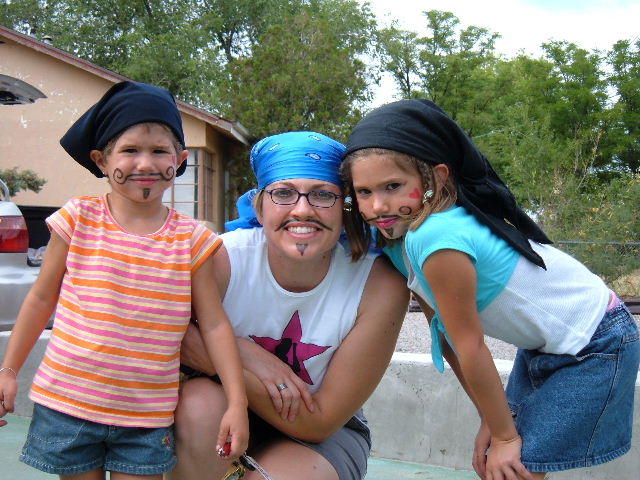
This was preparation for her Pirate Party for all 25 kids from her kindergarten class. The night before, she got a purple tulle tutu dress from her other auntie, replete with silver elbow gloves, silver purse, and jelly-glass slippers. She ran to the bathroom to try it on and emerged with her fanny showing from the back of the dress. She immediately grabbed her pirate sword and was therein deemed the Pirate Princess. And that's what she is.

The funniest part of the day was that I kept forgetting I was a pirate. I couldn't understand how the woman at Pizza Hut guessed my order was for a kids' party. Maybe because of the large cheese? But we ordered 2 green chile, and surely that should have thrown her off. Hmm... Then as I was sitting there waiting for the pizzas to be done, everyone coming in kept doing a double-take when they saw me. I'm thinking, I showered, so I can't look THAT bad, and I know I don't look that GOOD... What's going on?

And then it would hit me. Oh, right. I'm a pirate.

Friday, July 22, 2005

Cornucopia Me

Tapioca
blanding
next to mousse,

cabbage goodness
wilting
in panting breaths,

I’m terrible
in bite-size
pieces –

artichoke leaves
and
no heart,

peeling orange,
crab apple,
pineapple spines for miles –

a whole field
of wormy
corn.

How many ears does she have?
Why can’t she hear the difference
between planted and planned?

Words to remember

Virgo's NEVER get good horoscopes. We're the "straight" man to every other sign in the zodiac.

This month's horoscope is a lovely exception:

Virgo (Aug. 23-Sep. 22) You're in the process of a quick change of costume, or potentially an unexpected change of identity. You now get to put away an entire dimension of who you thought you were, and bring out someone you have long wanted to be. I suggest you indulge in the pleasure of this, and also in the pleasure of finally facing your worst fears. I mean, if you're going to bother to confront that which scares you, it might as well be what scares you most. You're in a rather fortunate position, as compared to those born in the other 11 signs of the zodiac: that state which is the most disturbing to you is precisely the position in which you are strongest. The true revolution of the moment is having arrived in the space where no one and nothing outside yourself has the power to tell you who you are.

Thursday, July 21, 2005

Over-analytical

What's so bad about thinking? I call it being conscious.

A friend just lost a friend, and one of the reasons given was that her friends (me among others) are just too analytical. We never stop.

I have friends that avoid me just because they're too tired or too ... happy? to dissect their lives day after day after day after day.

But that's what I do. It's what makes me feel alive and my life seem real. If I go too long without soul-searching, it's like I'm fast-forwarding my life, so there's no sound, no emotional attachment, no ... storylines to follow.

And as I've said before, I'm all about storylines. I'm all about finding the stories that make up my own life. I don't think life inherently has meaning; I think we create it. And if we're not creating it, we lose the opportunity to have it mean something.

I admit sometimes I get tired, and I just want to be zen-accepting of the moments as they come. And to be really honest, I'm that way more than anyone would believe. Mostly because I've so integrated the meaning-making that it's no longer an effort.

Those are the good days.

In the darkest moments, it's agonizing, but made valuable because I know that pain without meaning is just animal reaction. Pain with meaning is growth.

And so I grow. And trust me, the shooting pains are sometimes the very best stories. As long as they have a point.

Monday, July 18, 2005

Space Aliens

Space aliens have taken over my family. No really.

Met up with my sisters and brother-in-law because my favorite great-aunt's son, Norman, was in town. This was my grandmother's sister, one of a set of twins, my Aunt Dorris and Aunt Dottie. Both were fantastically nuts. Beautiful, artistic, and off-their-ass crazy.

My Aunt Dorris lived in Flagstaff and was a founding member of the bikini ski club. She also had a mousetrap with this shrivelled up Mexican bean that she'd chewed on to get it looking just right on her coffeetable for years.

My Aunt Dottie lived in San Diego. She had a recording of the worst opera singer ever to perform in Carnegie Hall. Turns out she was this rich debutante who rented the entire hall and put on a series of performances that sold out because people just had to hear for themselves how bad she really was.

Aunt Dottie died about 5 years ago. At the Renz family reunion in 2000, we all visited her grave -- or actually -- visited their grave. They've got a double-plot and double headstone. Aunt Dorris kissed her sister's side of the stone and then flopped down on her own grave and posed for a picture. "Yep, this will fit!" she screamed, amid peals of laughter.

For anyone who's met my grandmother, this picture of her sisters comes as something of a surprise. Nanny is as tight-lipped, judgmental, dour, sour, and uptight as they come. She was the oldest of five children raised by two very serious German immigrants on a farm in Michigan. Dottie and Doris were the babies of the family. As carefree as they were, the more work was left to my grandmother. They were indulged, to say the least. Everyone responded to them with joy; she got to play the straight man to their comic routines for the rest of her life.

But that's not my point of the day. My point of the day is this: My cousin Norman works for the Pentagon. He's been a test pilot his whole career, and although he recently retired, the Pentagon wooed him out of retirement to help improve the performance of weapons we're spending billions of dollars developing and then are unable to use because they lack reliability. Ahem.

Also not my point. Here's my point: we got to talking about aliens. My brother-in-law Darryl owned a very successful t-shirt company that made its name from the alien craze of the 90s, just in time for the anniversary of Roswell's Hanger 51 (or whatever number it was). It was called alienware, and I admit, it rocked. Some crazy started e-mailing Darryl first with information about classified events that broke the news weeks later and then with death threats, after which Darryl reported him to the FBI and never heard from him again.

The more we talked aliens, the less cousin Norman spoke up, until we all got the distinct impression that we should just shut up, because there was too much he couldn't say. That, or he was just trying to work out just how much DNA we share so that he could distance himself appropriately. One of the two.

Oh, and the other thing. For those of you 9-11 conspiracy theorists out there, Cousin Norman says the plane struck the ground in front of the Pentagon and then bounced up into the building, accounting for the lack of penetration in the building. And the Pennsylvania plane was most likely not blown out of the sky but rather broke apart in the nose dive to earth.

Wednesday, July 13, 2005

A Shameless Cut & Paste from Cyberspace

For you lovers of good writing, these are the 10 winners of this year's Bulwer-Lytton Contest ~ AKA Dark and Stormy Night Contest ~ (run by the English Department of San Jose State University), wherein one writes only the first line of a bad novel.

10) "As a scientist, Throckmorton knew that if he were ever to break wind in the echo chamber, he would never hear the end of it."

9) "Just beyond the Narrows, the river widens."

8) "With a curvaceous figure that Venus would have envied, a tanned, unblemished oval face framed with lustrous thick brown hair, deep azure-blue eyes fringed with long black lashes, perfect teeth that vied for competition, and a small straight nose, Marilee had a beauty that defied description."

[my personal fave, having just seen it happen in real life on an m-pyrical comment]

7) "Andre, a simple peasant, had only one thing on his mind as he crept along the East wall: 'Andre creep... Andre creep... Andre creep.'"

6) "Stanislaus Smedley, a man always on the cutting edge of narcissism, was about to give his body and soul to a back alley sex-change surgeon to become the woman he loved."

5) "Although Sarah had an abnormal fear of mice, it did not keep her from eeking out a living at a local pet store."

4) "Stanley looked quite bored and somewhat detached, but then penguins often do."

3) "Like an over-ripe beefsteak tomato rimmed with cottage cheese, the corpulent remains of Santa Claus lay dead on the hotel floor."

2) "Mike Hardware was the kind of private eye who didn't know the meaning of the word 'fear'; a man who could laugh in the face of danger and spit in the eye of death -- in short, a moron with suicidal tendencies."

AND THE WINNER IS.....

1) "The sun oozed over the horizon, shoved aside darkness, crept along the greensward, and, with sickly fingers, pushed through the castle window, revealing the pillaged princess, hand at throat, crown asunder, gaping in frenzied horror at the sated, sodden amphibian lying beside her, disbelieving the magnitude of the frog's deception, screaming madly, 'You lied!'"

Heading Internal

Time to pull in for some major self-tuning. Journaling the other night, I realized just how much of my life is driven by the powerful fear of rejection. It's amazing to me how intensely I crave the sensation of being "special" -- in whatever way. To be perfectly honest (in a blog? really? yes, really.), I think that's the root of my perfectionism. The whole love-through-performance syndrome. And when I'm not in touch with myself -- really listening and seeing who I am -- I find myself relying on other people's perceptions of me to feed that gigantic furnace that is self-esteem.

It's eerie, though, because as soon as I take the time -- literally spend the time -- to be with myself, I remember that I do like and value who I am. I remember that I don't have to convince anyone, and if they need convincing, I don't need them in my life.


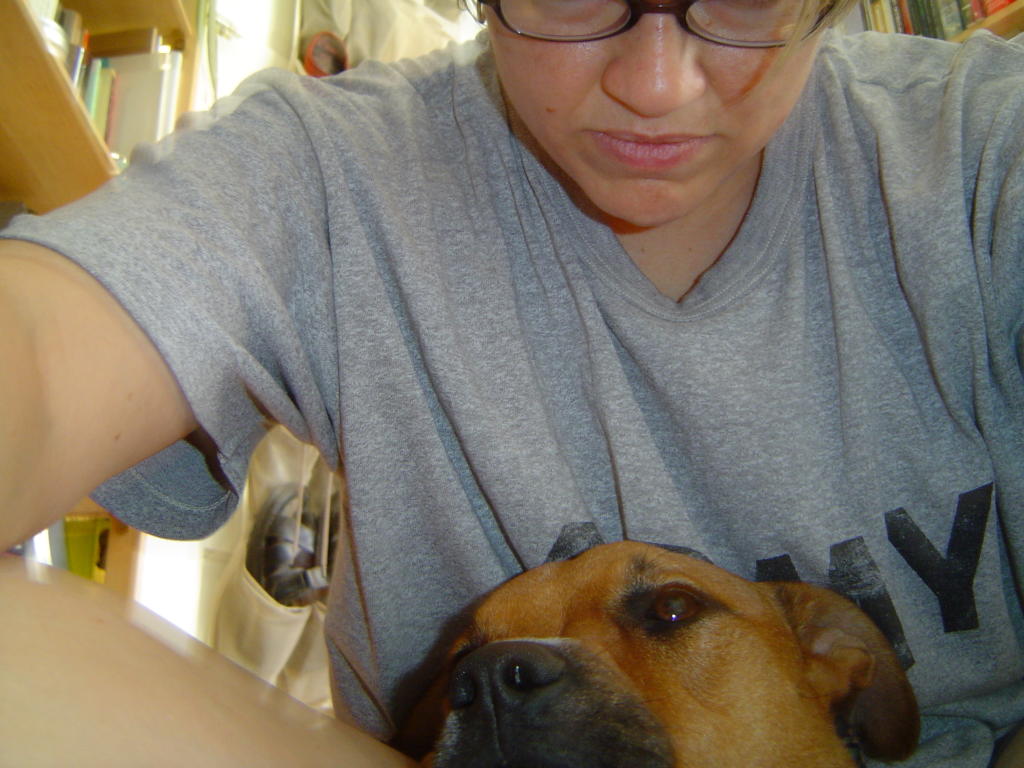
So, here's a picture of me and my biggest source of unconditional love. Ah, that we could feel this adored all the time. It's a horrible self-portrait, but it does speak volumes about the connection between me and the pup.

Here's to all inward journeys.

Saturday, July 09, 2005

Strange Silence

Everything's moving so fast, but somehow I'm not panicked, because I sense strongly that things are actually revolving, which means I don't have to track anything. If I miss it, it will be back soon enough, and I can try to deal with it again at that point, and maybe I'll have more of what I need to be effective or patient or loving or strong or assertive or graceful.

I don't have many words of my own at the moment. Narrative fails me. So I offer the poems below from a new treasure trove of a poet: Simon Ortiz of Acoma pueblo.

Thanks to Levi Romero for turning me onto him. I've immersed myself in his book Woven Stone, a collection of several of his early volumes. And I mean volumes.

Another hint about where I am:

Virgo (August 23-September 22)
You’re being asked to live without something, or to live as if you were without it. Think of this something as part of yourself. Imagine that you’re in a psychological experiment where you’re relieved of the burden of self-consciousness. You’re free to be you without that peculiar human quality of regret, or of seeking something better in the past or future. Note how you relate to your own needs in this space, particularly your need for companionship. Notice how it feels to offer yourself to others from this unusual point of clarity.

Evening Beach Walk

by Simon Ortiz

I don’t really feel like walking
at first
but somehow I feel I must
since I have come
this far
to this edge,
and so I walk.

The sun is going downwards
or rather one point changes to another,
and I know I am confronting
another horizon.

A dog comes sniffing at my knees
and I hold my hand to him,
and he sniffs, wags his tail
and trots away to join a young couple,
his friends, who smile as we meet.

I look many times as the sun sets
and I don’t know why I can’t see
clearly the horizon I’ve imagined.
Maybe it’s the clouds, the smog
maybe it’s the changing.

It’s a duty with me,
I know, to find the horizons,
and I keep on walking on the ocean’s edge,
looking for things in the dim light.

What I Mean

by Simon Ortiz

Agee. I don’t mean that Agee,
I mean Agee from home.
He was just one of us, but a hero.
I mean not in a big way but real,
because he was one of us.

He was a young guy
who never got beyond nineteen.
We were the same age though in school
he was always behind
and the teachers were always on him
for not doing well.
Agee was always laughing and fooling around
and talking Indian
(you couldn’t do that)
and making English sound like Indian
(you couldn’t do that either.)
English had to be English,
that was the real American way,
and Indian was just Indian—
the teachers so much as said that to us.

Agee quit school in junior high
and went to work in the mines.
He went to work because his family was poor
like all our families were poor.
He was one of the first guys from home
in the mines and probably the youngest.
After high school when I started working
for Kermac Mill at Ambrosia Lake,
he was at Haystack working underground.

You know it’s funny—
I mean this: teachers in school
were always on him
because he couldn’t read
(or wouldn’t)
or couldn’t talk English
(or wouldn’t)
but once when I was in Grandma’s Café
in Milan where the guys I rode with
sometimes stopped to pick up bag lunches,
I was surprised.
Grandma’s was usually crowded
with miners and millworkers
but not many of us Indians
ever went in there, and Agee was there.
And he was talking. I mean talking.

That may not sound like a big deal,
but this is what I mean:
We didn’t talk much.
Some people say Indians are just like that,
shy and reserved and polite,
but that’s mostly crap. Lots of times
we were just plain scared
and we kept our mouths sut.
I mean Grants and Milan and the mines
between haystack and Ambrosia Lake,
all that area used to be Indian land—
Acoma land—but it was surveyed
by the government and stolen
at the turn of the century
and there was plenty to say
but we didn’t say it.
I mean being Indian wasn’t the safest
thing to be in town
so we didn’t say much, much less
be in Grandma’s Café arguing
with white miners who made jokes
about squaws and called you chief.
I mean Agee was talking.

And he was reading too,
from the union contract
which was the issue of the argument.
That was right before the strike in 1961.
Most of us few Indian workers
didn’t know much
about the mine unions and Agee
wsa one of the first members from home
and he was arguing for the strike.
As I said before, most of us
didn’t say much of anything.
We were just glad for the jobs we had,
union or no union, but Agee,
when te workers went out on strike later,
spoke for us saying that Indians
were just like other workers
and he wasn’t shy or reserved
saying that in English that sounded
Okie and Mexican and Indian.

Later on,
Agee went down to Silver City
when the workers went on strike there.
He was always doing that,
helping folks, especially old folks,
and it didn’t matter who.
Well, down there, one night,
he was changing a tire
or pushing a stalled car or something,
he was struck accidentally—
that’s what they told folks at home,
and maybe it was. And maybe too
it was because Agee was
just another worker,
just another Indian,
there was nothing else necessary
for them to tell us.

But what I mean is:
Although Agee never made it beyond young,
the mines were still there
and the workers were still fighting
and old people still needed help
and the language of our struggle
just sounds and reads like an Indian,
Okie, Cajun, Black, Mexican hero story—
that’s what we mean.
That’s what we mean.
Wednesday, June 22, 2005

Dog Days

Apparently it's my year for doggy drama. First losing Izzi in October to a rare heart explosion.

Then my friend Rob asks me to dog-sit for his brother for a month. No problem, right? Sweet dog. Calm. Smart. Chocolate lab -- very soulful eyes.

But he's an escape artist, and soon he and Cleo are out on the town. He returns like a gentleman a day later, strolls right back through the back door as though in from a jaunt.

Cleo takes advantage of the freedom and ROAMS. Flyers and many panic attacks later, I call about a cryptic note on the Animal Services Website: "Female tan pitbull. Age unspecified." Worth a call, right? She's been found by Paul, who sounds nice enough. I describe Cleo, he describes the dog he met, and they don't seem to match up. His mention of the brindle on her belly is particularly disappointing. That's not my sweet girl. He's had her chip read, and it came up with a couple of names from somewhere in the NE heights. Doesn't sound like my dog. But he says, you should come by or else we'll always wonder. Wise man. So I hop on my bike on one of the hottest afternoons of this summer, and haul up to Stanford and Lead -- a good five miles from my house at least. And there she is. All unapologetic smiling girl herself.

Bring her home -- she's all casual. I'm in disbelief but happy -- sooooooo happy. I really didn't think I'd see her again.

The next morning, the dogs are in the front yard. I'm changing to take them for a long Sunday morning hike. Hobbes slips through the picket slats, Cleo follows, I run down screaming at them both, and suddenly, Cleo can't walk on one of her legs. She holds it at an odd angle as she hops around. But it serves her right, right? This will teach her! She'll hobble around for a couple days, and then she'll be fine.

Only she doesn't get better. She can't get comfortable. She's sitting on her knees holding herself up with her front legs. It looks awkward and painful, with her leg crumpled beneath her. I take pity and take her to the vet. They have no time for an appointment, so I drop her off so they can take x-rays when they have a minute during the day.

Bad news: her hip is dislocated, and she'll need surgery. So I try to make her an appointment at the surgery clinic, but of course they can't get her in until the morning. We wait 45 minutes in the lobby, where she can't calm down, and each time she settles, another dog comes along and gets her up and agitated. It takes the surgeon 10 minutes to say there's no hope for reconstruction (it's been too long since the original trauma, which we're still not sure of -- maybe she got hit by a car? No guilt about waiting to take her in. None at all! Gulp.) unless I want to replace her hip altogether for the bargain price of $3700. Ummm... what's the next best option? Cutting off her femur.

What's that? You heard right. They cut off the top of the femur so that the bone no longer comes in contact with the hip. The dog can walk on the leg, but she'll never be able to run normally or for very long. There goes jogging. And one of the reasons I got a dog is to go jogging and feel safe. Guess it's time for yoga! Lots of down dogs. Literally.

So I take her back to my vet, where at least she got good attention and lots of love. In fact, the nurse offered to take her home -- okay actually threatened to steal her -- AFTER I pay for the surgery. That was funny. At least, I think she was kidding. She was. She's the sweetest vet assistant ever. Cheers to the Manzano Animal Clinic. Best vet in town.

But of course they can't do the surgery until tomorrow, so 2.5 hours and 3 car trips later, I take Cleo home, drug her up, and head to work.

Tomorrow's the big day. Say bye bye to cartillage.

I've been telling people I'm going to have to get one of those medical tags that declares her condition so that the next time she escapes whoever finds her will know she's missing a hip and shouldn't run! I can just see Mr. Skateboarding trying to leash her up again for a quick pull and running over her when she falls!

Send us your fastest healing wishes. We'll need them.

Friday, June 10, 2005

Knowing Stories

What stories I know about these people I will share with you.
The stories begin with the men and always end with the women;
that’s the way it is in our family. – Denise Chavez, Face of an Angel

I know no stories,
and the ones whose shadows
seem familiar
were probably lies.

Maybe not lies
but no one in my family
wanted to fess up
about the truth of his or her
own experience

Maybe they just had no faith
in the ability to communicate
what can only be personal
chaos – the randomness
of our days – the crazy
juxtaposition of events –
and the inevitability of an end
that never comes
until it does.

Our family holds secrets
that encompass whole lifetimes
eclipse whole personalities
bury connections of blood
that will never grow beyond family.

We are not friends;
we cannot know each other.

What I know about my family
I take on faith.

The Fortune Cookie

An old dream you thought was lost will reoccur.

And it will slay you
pulled back into old nightmares
you’d killed by never sleeping
pinching the chair to see the moon
every second
without blinking –

Too tight to follow cases that lift above security lights
stop
empty pockets
unlace your shoes
and walk with bowed head
through our century’s gothic arches

We lift off
fingers gripping
shared armrests
that assert and question
our personal space

We race to visit cultures more exotic
than our own

When in foreign markets
that dream you once thought lost
glistens to you
from between naranjas

It picks you up in seedy bars
limbos under your expectations
gathers limbs reaching to capture a moment
before the worst had already happened to you –

This dream, growing slowly
in the black light
of back-yard, drug-store hothouse
seems as simple to you now
as it did then
with room to spare
for everything that doesn’t come easy.

Friday, June 03, 2005

Thesis Check-in

My library books are all overdue. Can't imagine why. I've had some of them checked out since 2004. Not kidding.

Right now, I'm reading about the importance of culture to identity in a little book with a great title: Cultures, Communities, Identities : Cultural Strategies for Participation and Empowerment. The title's better than the book, which focuses on community art and theatre in creating identity. Good in its own right if you're interested in those things. For me, I really want the physical design/place aspect, which is missing from this book.

The other thing is a discussion in urban geography about how to delimit communities within urban areas. This is a rather central question to my thesis, but in a method backward from the discussion in the book. The book says, how can you find sub-areas within a city? They're there, but how do you know when you've properly defined them so that you can study them separately? My thesis asks, how can a community delimit itself so that it can BECOME a sub-area within a city? How do they go about setting themselves off? Is it enough to give themselves a name? Do they have to make physical changes? Is there an empirical reason to become a sub-area, other than the simple fact that they want to be? Maybe the sub-areas in this sub-area should be delimited, instead.

The basic question is still about the relationship between place and identity in a North Valley neighborhood. Which comes first? Which is most important to this community? How can one serve to create the other? Basically, I'm taking the position that you can’t just jump to identity. This neighborhood wants to declare an identity (in this case a district name), thinking that that will help create place. I say they have some work to do first and foremost to organize themselves and make sure everyone has a voice in the process and secondly to enhance the built environment to reflect the kind of place they want this to eventually be.

In a slight aside and in reference to a comment my very smart friend Cassy made when I last posted about the thesis (in February -- ahem), I found a great article by Sudhir Venkatesh about Chicago's neighborhood names. Chicago is one of the most-studied cities in the world. In the early 20th century, the University of Chicago sent out an army of researchers to "discover" the neighborhoods in Chicago and begin gathering data on them over time in Community Fact Books that came out every year. All of that is standard knowledge. What you don't hear much about is how the researchers chose the names for many of the neighborhoods, or adjusted the boundaries, based on their own preferences or in order to fit the data already gathered or simply data-gathering in the future. Then the head researchers, Burgess and Park, spent a lot of time and energy getting the names accepted by the communities, by the city, by the businesses (especially white pages -- which they got separated by neighborhood), and finally -- by the U.S. Census Bureau. Originally, the census had its own neighborhood designations for Chicago, but Burgess and Park convinced them to use their delineations in order to facility their own data gathering down the road. And for the most part, their efforts have paid off. Now these neighborhood names and boundaries are institutionalized and exist to this day.

So it can be done. Names can create places (with help from natural boundaries like roads and landscape features). The question remains: should it be done in this case of a neighborhood at the crossroads of 4th and Montano?

Wednesday, June 01, 2005

"Speaking of Gabriel" -- Rosario Castellenos

This from a beautiful book called These are not sweet girls, an anthology of Latin American women poets.

Speaking of Gabriel

Like all guests my son got in the way
taking up a space that was my space,
existing at all the wrong times,
making me divide each bite in two.

Ugly, sick, bored,
I felt him grow at my expense,
steal the color from my blood, add
clandestine weight and volume
to my way of being upon the earth.

His body begged for birth, begged me to let him pass,
allot him his place in the world,
and the portion of time he needed for his history.

I agreed. And through the wound of his departure,
through the hemorrhage of his breaking free,
the last I ever felt of solitude, of myself
looking through a pane of glass, also slipped away.

I was left open, an offering
to visitations, to the wind, to presence.

Friday, May 27, 2005

Shine -- Nicole Blake

she is fifteen but amazed
when i sign to her that
the sun cannot be heard
even on its brightest days

Seattle Poetry Bus 1999

How to Make A Box -- Kathleen Flenniken

Find someone with cuts to match
your cuts, lines to meet your lines.
Fold yourself to fit, as required.
Some parts of you may interlock.
Cut out a window and use for a handle.
Carry a secret or make a display.
Hold it together or pull it apart.
You decide what to keep inside.

Seattle Poetry Bus 1999

The War Prayer -- Mark Twain

It was a time of great and exalting excitement. The country was up in arms, the war was on, in every breast burned the holy fire of patriotism; the drums were beating, the bands playing, the toy pistols popping, the bunched firecrackers hissing and spluttering; on every hand and far down the receding and fading spread of roofs and balconies a fluttering wilderness of flags flashed in the sun; daily the young volunteers marched down the wide avenue gay and fine in their new uniforms, the proud fathers and mothers and sisters and sweethearts cheering them with voices choked with happy emotion as they swung by; nightly the packed mass meetings listened, panting, to patriot oratory which stirred the deepest deeps of their hearts, and which they interrupted at briefest intervals with cyclones of applause, the tears running down their cheeks the while; in the churches the pastors preached devotion to flag and country, and invoked the God of Battles beseeching His aid in our good cause in outpourings of fervid eloquence which moved every listener. It was indeed a glad and gracious time, and the half dozen rash spirits that ventured to disapprove of the war and cast a doubt upon its righteousness straightway got such a stern and angry warning that for their personal safety’s sake they quickly shrank out of sight and offended no more in that way.

Sunday morning came—next day the battalions would leave for the front; the church was filled; the volunteers were there, their young faces alight with martial dreams—visions of the stern advance, the gathering momentum, the rushing charge, the flashing sabers, the flight of the foe, the tumult, the enveloping smoke, the fierce pursuit, the surrender! Then home from the war, bronzed heroes, welcomed, adored, submerged in golden seas of glory! With the volunteers sat their dear ones, proud, happy, and envied by the neighbors and friends who had no sons and brothers to send forth to the field of honor, there to win for the flag, or, failing, die the noblest of noble deaths. The service proceeded; a war chapter from the Old Testament was read; the first prayer was said; it was followed by an organ burst that shook the building, and with one impulse the house rose, with glowing eyes and beating hearts, and poured out that tremendous invocation—“God the all-terrible! Thou who ordainest! Thunder thy clarion and lightning thy sword!”

Then came the “long” prayer. None could remember the like of it for passionate pleading and moving and beautiful language. The burden of its supplication was, that an ever-merciful and benignant Father of us all would watch over our noble young soldiers, and aid, comfort, and encourage them in their patriotic work; bless them, shield them in the day of battle and the hour of peril, bear them in His mighty hand, make them strong and confident, invincible in the bloody onset; help them to crush the foe, grant to them and to their flag and country imperishable honor and glory—

An aged stranger entered and moved with slow and noiseless step up the main aisle, his eyes fixed upon the minister, his long body clothed in a robe that reached to his feet, his head bare, his white hair descending in a frothy cataract to his shoulders, his seamy face unnaturally pale, pale even to ghastliness. With all eyes following him and wondering, he made his silent way; without pausing, he ascended to the preacher’s side and stood there waiting. With shut lids the preacher, unconscious of his presence, continued with his moving prayer, and at last finished it with the words, uttered in fervent appeal, “Bless our arms, grant us the victory, O Lord our God, Father and Protector of our land and flag!”

The stranger touched his arm, motioned him to step aside—which the startled minister did—and took his place. During some moments he surveyed the spellbound audience with solemn eyes, in which burned an uncanny light; then in a deep voice he said:

“I come from the Throne—bearing a message from Almighty God!” The words smote the house with a shock; if the stranger perceived it he gave no attention. “He has heard the prayer of His servant your shepherd, and will grant it if such shall be your desire after I, His messenger, shall have explained to you its import—that is to say, its full import. For it is like unto many of the prayers of men, in that it asks for more than he who utters it is aware of—except he pause and think.

“God’s servant and yours has prayed his prayer. Has he paused and taken thought? Is it one prayer? No, it is two—one uttered, the other not. Both have reached the ear of Him Who heareth all supplications, the spoken and the unspoken. Ponder this—keep it in mind. If you would beseech a blessing upon yourself, beware! lest without intent you invoke a curse upon a neighbor at the same time. If you pray for the blessing of rain upon your crop which needs it, by that act you are possibly praying for a curse upon some neighbor’s crop which may not need rain and can be injured by it.

“You have heard your servant’s prayer—the uttered part of it. I am commissioned of God to put into words the other part of it—that part which the pastor—and also you in your hearts—fervently prayed silently. And ignorantly and unthinkingly? God grant that it was so! You heard these words: ‘Grant us the victory, O Lord our God!’ That is sufficient. The whole of the uttered prayer is compact into those pregnant words. Elaborations were not necessary. When you have prayed for victory you have prayed for many unmentioned results which follow victory—must follow it, cannot help but follow it. Upon the listening spirit of God fell also the unspoken part of the prayer. He commandeth me to put it into words. Listen!

“O Lord our Father, our young patriots, idols of our hearts, go forth to battle—be Thou near them! With them—in spirit—we also go forth from the sweet peace of our beloved firesides to smite the foe. O Lord our God, help us to tear their soldiers to bloody shreds with our shells; help us to cover their smiling fields with the pale forms of their patriot dead; help us to drown the thunder of the guns with the shrieks of their wounded, writhing in pain; help us to lay waste their humble homes with a hurricane of fire; help us to wring the hearts of their unoffending widows with unavailing grief; help us to turn them out roofless with little children to wander unfriended the wastes of their desolated land in rags and hunger and thirst, sports of the sun flames of summer and the icy winds of winter, broken in spirit, worn with travail, imploring Thee for the refuge of the grave and denied it—for our sakes who adore Thee, Lord, blast their hopes, blight their lives, protract their bitter pilgrimage, make heavy their steps, water their way with their tears, stain the white snow with the blood of their wounded feet! We ask it, in the spirit of love, of Him Who is the Source of Love, and Who is the ever-faithful refuge and friend of all that are sore beset and seek His aid with humble and contrite hearts. Amen.

(After a pause.) “Ye have prayed it; if ye still desire it, speak!—The messenger of the Most High waits!”

It was believed afterward that the man was a lunatic, because there was no sense in what he said.