So my lesson of the week is this:
Be specific when you put requests out in the universe.
This week for me is all about synchronicity. I got myself centered and asked for clarity. My relationship ended. I asked for updates to my computer. My computer got stolen, and I'm faced with replacing it. I asked for movement toward a career working for communities. I got a new job -- that starts the day after a major deadline at my old one. I asked for a little extra money, and I got it -- along with major new needs -- for a place to live, setting up shop, and all new technology. I asked for motivation to work on the thesis. I lost my reference database.
And through it all, my prevailing thought is, wow. The universe really has big plans for me! There's no equivocating on the message: MOVE MOVE MOVE MOVE MOVE. After all, that's life. We're vessels: get ready to float, cause it's starting to rain. Scrap that; it's storming!
Energy flows. Where there's an opening, it moves. I have to believe that's why all of this is happening at once. I am the opening. I am open. I open.
Friday, March 25, 2005

Monday, March 21, 2005
Girls Weekend
Went to Santa Fe with the m-pyre trio and talked and ate and drank and talked some more.
Here is what I wrote on the subject:
Today with the girls, and I know that no matter what -- NO MATTER WHAT -- I will become who I want to be, and all will be well. Maybe not all as I'd want or all as I'd dream or expect or reason for myself -- but well. As it should be. With friends around me who love me just for who I am and what I believe. It's downright affirming.
And boys -- while important and a frequent topic -- shrink to their rightful proportions. Important but peripheral. Central, even, maybe -- but additive. This is what you must remember when falling in love. That life takes two feet, on the ground at all times.
Today I picture brown babies and imagine turning 30 as a release from all the fears that my dreams won't come true. Time to make the hard decisions and live happy anyway.
Today, here with my heart friends who just now are learning they belong here, I enjoy this place -- my life -- my self. I feel downright centered. It is light.
Here is what I wrote on the subject:
Today with the girls, and I know that no matter what -- NO MATTER WHAT -- I will become who I want to be, and all will be well. Maybe not all as I'd want or all as I'd dream or expect or reason for myself -- but well. As it should be. With friends around me who love me just for who I am and what I believe. It's downright affirming.
And boys -- while important and a frequent topic -- shrink to their rightful proportions. Important but peripheral. Central, even, maybe -- but additive. This is what you must remember when falling in love. That life takes two feet, on the ground at all times.
Today I picture brown babies and imagine turning 30 as a release from all the fears that my dreams won't come true. Time to make the hard decisions and live happy anyway.
Today, here with my heart friends who just now are learning they belong here, I enjoy this place -- my life -- my self. I feel downright centered. It is light.
Tuesday, March 01, 2005






Thursday, February 03, 2005
Thesis Proposal Anyone?
Hey, kids. If anyone wants to know where I am and what I'm doing in the next six months, direct them here. I've included my latest thesis proposal so that my friends, family, and ... employers ... ahem ... can know what I'm spending all my time on. Please direct all correspondence, condolensces, ideas, and suggested readings here. See you in October.
Issue
During a facilitated community visioning, residents of the area surrounding 4th Street and Montano in Albuquerque’s North Valley expressed a desire for a district identity. Some talked about identity in terms of marketing – a kind of branding to increase tourism and promote economic revitalization of the 4th Street corridor. Others talked about being able to refer to the place where they live with a name, versus an intersection, which itself is problematic and troublesome to many area residents. Still others talked about developing an identity as a reason for the community to come together in the process of choosing a name for itself – a kind of community organizing that would include examining their collective values in order to choose one name that could encapsulate their vision and love for this place.
Despite the differences in the ways residents talked about identity, all seemed to agree that identity had a direct relationship with “place-making” through physical improvements that would both reflect the community’s self-imposed identity and help to enrich and protect it.
Problem
In this thesis, I propose to examine residents’ desires for identity and begin to tease out the values, goals, and implications embedded in their various definitions. Only by understanding what residents hope to achieve through “identity” can proposals be made for a process to get them there and outline next steps to take.
It will also be important to look closely at who was included in this initial conversation and who was not, which may indicate not only the subject position of those present, but also the social divisions in the community that may complicate the selection of a “collective identity.” Perhaps because of the methods used to gather community participation in this particular visioning process, residents seemed to be similar in class, values, ethnicity, and residency. This similarity among these residents may have led them to assume more homogeneity in the wider community than may really exist. The community’s diversity must be taken into account in any discussion of a process to create a community identity – whether through assuming a name or through place-making physical improvements.
In general, I intend to problematize the concept of identity itself, exploring not just how and why residents’ definitions vary, but also to determine whether physical improvements to the area could achieve the kind of place-making that residents’ desire for identity seemed to imply. If so, a process of community design might simultaneously avoid the problematic issues raised by residents’ current ways of talking about identity – such as identity as market branding or condensing multiple values and perspectives of what this place should be into one name – while creating a shared sense of place that allows for multiple perspectives, a variety of ways to use it, and eventually perhaps a name that arises once the neighborhood becomes what residents’ want it to be.
This thesis posits that instead of picking a name that will inspire the physical form and desired economic development, residents should focus on making the physical improvements that will first and foremost create the place residents want it to be, with the secondary benefit of bringing the community together through a participatory design process, and a tertiary benefit of eventually inspiring a name.
The final portion of the thesis will include a visual analysis of the cultural landscape and a proposal for a participatory urban design process.
Outline
I. Introduction: Briefly set 4th Street/Montano context, visioning process, thesis
II. Theory: Operational definitions for “identity” & “place-making” and problematics
III. Neighborhood Process & Mapping Data: Link examples to theory
a. Community Visioning Process explained
b. Workshop I maps
c. Workshop II discussions/maps
IV. Visual analysis
a. Cultural Landscape Reading (existing conditions)
b. Kevin Lynch nodes, districts, edges, paths, landmarks
V. Proposals/Recommendations
a. Physical: potential improvements – strengthening connections
and enhancing what works
b. Process: participatory community designCautions: Recap of identity
problematics, history/cultural appropriation, homogenization
c. Cautions: Recap of identity problematics, history/cultural appropriation,
homogenization
Issue
During a facilitated community visioning, residents of the area surrounding 4th Street and Montano in Albuquerque’s North Valley expressed a desire for a district identity. Some talked about identity in terms of marketing – a kind of branding to increase tourism and promote economic revitalization of the 4th Street corridor. Others talked about being able to refer to the place where they live with a name, versus an intersection, which itself is problematic and troublesome to many area residents. Still others talked about developing an identity as a reason for the community to come together in the process of choosing a name for itself – a kind of community organizing that would include examining their collective values in order to choose one name that could encapsulate their vision and love for this place.
Despite the differences in the ways residents talked about identity, all seemed to agree that identity had a direct relationship with “place-making” through physical improvements that would both reflect the community’s self-imposed identity and help to enrich and protect it.
Problem
In this thesis, I propose to examine residents’ desires for identity and begin to tease out the values, goals, and implications embedded in their various definitions. Only by understanding what residents hope to achieve through “identity” can proposals be made for a process to get them there and outline next steps to take.
It will also be important to look closely at who was included in this initial conversation and who was not, which may indicate not only the subject position of those present, but also the social divisions in the community that may complicate the selection of a “collective identity.” Perhaps because of the methods used to gather community participation in this particular visioning process, residents seemed to be similar in class, values, ethnicity, and residency. This similarity among these residents may have led them to assume more homogeneity in the wider community than may really exist. The community’s diversity must be taken into account in any discussion of a process to create a community identity – whether through assuming a name or through place-making physical improvements.
In general, I intend to problematize the concept of identity itself, exploring not just how and why residents’ definitions vary, but also to determine whether physical improvements to the area could achieve the kind of place-making that residents’ desire for identity seemed to imply. If so, a process of community design might simultaneously avoid the problematic issues raised by residents’ current ways of talking about identity – such as identity as market branding or condensing multiple values and perspectives of what this place should be into one name – while creating a shared sense of place that allows for multiple perspectives, a variety of ways to use it, and eventually perhaps a name that arises once the neighborhood becomes what residents’ want it to be.
This thesis posits that instead of picking a name that will inspire the physical form and desired economic development, residents should focus on making the physical improvements that will first and foremost create the place residents want it to be, with the secondary benefit of bringing the community together through a participatory design process, and a tertiary benefit of eventually inspiring a name.
The final portion of the thesis will include a visual analysis of the cultural landscape and a proposal for a participatory urban design process.
Outline
I. Introduction: Briefly set 4th Street/Montano context, visioning process, thesis
II. Theory: Operational definitions for “identity” & “place-making” and problematics
III. Neighborhood Process & Mapping Data: Link examples to theory
a. Community Visioning Process explained
b. Workshop I maps
c. Workshop II discussions/maps
IV. Visual analysis
a. Cultural Landscape Reading (existing conditions)
b. Kevin Lynch nodes, districts, edges, paths, landmarks
V. Proposals/Recommendations
a. Physical: potential improvements – strengthening connections
and enhancing what works
b. Process: participatory community designCautions: Recap of identity
problematics, history/cultural appropriation, homogenization
c. Cautions: Recap of identity problematics, history/cultural appropriation,
homogenization
Friday, January 14, 2005
Morality of Connection
So I haven't worked this out all the way yet, but I've been looking around lately and noticing that I need a way to see the world that reminds me of what to strive for and not just a way to hate and fear the injustice and selfishness I see.
I keep coming back to my own sense that connection is the foundation of all ethics. As you know, I've been reading about the latest discoveries in quantum physics. I won't bore you with the details, but at the most basic, physicists think they've discovered the connective piece that ties all theories together, a piece that explains how our universe went from big bang to the floating particles that make up our daily experience. They're calling this superstring theory (which is fascinating and everyone should know more about it), but what's important is that it seems to prove that we are all connected. The universe may be expanding, but at a fundamental level, gravity and all other forces actually strive for connection. You've heard that all things are relative, right? Some detractors say that the theory of relativity spelled the end of enforceable morality because how can anyone be held accountable for actions when all things are relative?
What scientists have discovered is that all things are relative because all things are connected. This makes sense. Things are relative because they are in relationship. What this means in terms of morality is that you and I can have different ideas of what is moral, but our actions in relation to one another must always honor that on all levels, we are connected. I may hate what you think or do, but if I act to isolate or expell you, I am acting in violation of the laws of the universe. If, on the other hand, I act to understand why you believe what you believe or work to find a way for both of us to agree about a common response to whatever it is, then I am acting morally. The things that bring us together are what is real and moral because they reflect the truth of our universe.
Just think about all the ways this plays out in different situations. Compromise is moral; violence is immoral. Reform is moral (because you work to give someone the skills they need to live in communion with others and thereby bring someone back into community); capital punishment is immoral. Polluting is immoral; deep ecology is moral. Love and family are moral; denouncing one segment of society for the way in which they express love is immoral.
In reality, this sense of connection is at the heart of almost all world religions. Those religions that I find repugnant are those that put one set of beliefs against all others or one people against all others. The religions that embrace, the religions that acknowledge our deep connection with the world around us, the religions that praise compassion and understanding -- these are the moral religions founded in life and reality. These are religions about union, communion, community, connection.
Even pyschology works in this way. The healthiest individuals are those who can love and support, and accept love and support in return. The sickest among us are those who are unsocial. Psychopaths are those who feel no connection to anyone. They can feel no respect for life. Doesn't it hold, then, that the opposite -- those with a fundamental respect for life (which at its base is about connection) -- are those with the strongest moral base?
The other critical element in all of this is the idea of individuality. All particles in the universe are simultaneously discrete and connected. We are simultaneously matter and energy, just as we are simultaneously individuals and community. This means we must honor individuality as much as we honor connection. Those things that seek to gloss over our rights as individuals are as much in violation of universal laws as those that seek to profit just one elite group.
What an elegant universe, with so much to teach us about ourselves and our lives and our actions! It is so easy to fall into the trap of disregarding those who hold opinions we don't share. It is hard to remember that by doing so we violate the connections between us.
So here's to communion and to the peacemakers, the physicists, the poets, and all others who conceive of the metaphors that bring us together.
May we feel the connections more strongly than those forces that seek to pull us apart -- the forces of fear and anger and righteousness.
May all of us find peace.
I keep coming back to my own sense that connection is the foundation of all ethics. As you know, I've been reading about the latest discoveries in quantum physics. I won't bore you with the details, but at the most basic, physicists think they've discovered the connective piece that ties all theories together, a piece that explains how our universe went from big bang to the floating particles that make up our daily experience. They're calling this superstring theory (which is fascinating and everyone should know more about it), but what's important is that it seems to prove that we are all connected. The universe may be expanding, but at a fundamental level, gravity and all other forces actually strive for connection. You've heard that all things are relative, right? Some detractors say that the theory of relativity spelled the end of enforceable morality because how can anyone be held accountable for actions when all things are relative?
What scientists have discovered is that all things are relative because all things are connected. This makes sense. Things are relative because they are in relationship. What this means in terms of morality is that you and I can have different ideas of what is moral, but our actions in relation to one another must always honor that on all levels, we are connected. I may hate what you think or do, but if I act to isolate or expell you, I am acting in violation of the laws of the universe. If, on the other hand, I act to understand why you believe what you believe or work to find a way for both of us to agree about a common response to whatever it is, then I am acting morally. The things that bring us together are what is real and moral because they reflect the truth of our universe.
Just think about all the ways this plays out in different situations. Compromise is moral; violence is immoral. Reform is moral (because you work to give someone the skills they need to live in communion with others and thereby bring someone back into community); capital punishment is immoral. Polluting is immoral; deep ecology is moral. Love and family are moral; denouncing one segment of society for the way in which they express love is immoral.
In reality, this sense of connection is at the heart of almost all world religions. Those religions that I find repugnant are those that put one set of beliefs against all others or one people against all others. The religions that embrace, the religions that acknowledge our deep connection with the world around us, the religions that praise compassion and understanding -- these are the moral religions founded in life and reality. These are religions about union, communion, community, connection.
Even pyschology works in this way. The healthiest individuals are those who can love and support, and accept love and support in return. The sickest among us are those who are unsocial. Psychopaths are those who feel no connection to anyone. They can feel no respect for life. Doesn't it hold, then, that the opposite -- those with a fundamental respect for life (which at its base is about connection) -- are those with the strongest moral base?
The other critical element in all of this is the idea of individuality. All particles in the universe are simultaneously discrete and connected. We are simultaneously matter and energy, just as we are simultaneously individuals and community. This means we must honor individuality as much as we honor connection. Those things that seek to gloss over our rights as individuals are as much in violation of universal laws as those that seek to profit just one elite group.
What an elegant universe, with so much to teach us about ourselves and our lives and our actions! It is so easy to fall into the trap of disregarding those who hold opinions we don't share. It is hard to remember that by doing so we violate the connections between us.
So here's to communion and to the peacemakers, the physicists, the poets, and all others who conceive of the metaphors that bring us together.
May we feel the connections more strongly than those forces that seek to pull us apart -- the forces of fear and anger and righteousness.
May all of us find peace.
Tuesday, January 11, 2005
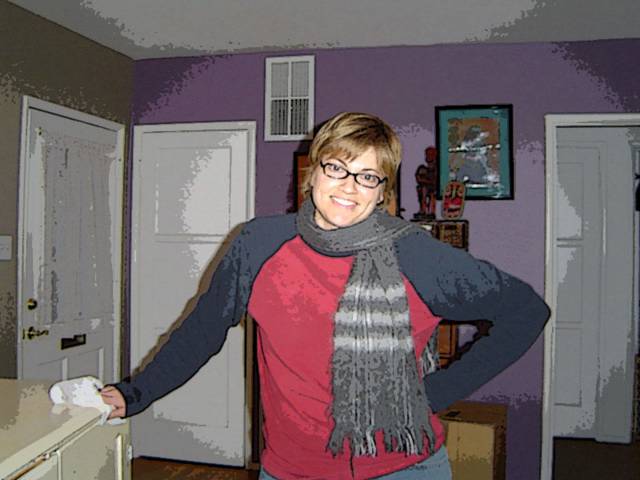
Guess who got a digital camera for Christmas?
I'll give you a hint: we did.
The whole digital world is great for sharing via blog, but I have to admit, I'll probably never print them. I'm not on-board with the whole print revolution. I'm a technocrat, but I'm also a cheapskate.
I thought there would be something lacking with digital insta-gratification that takes away from the surprise of opening your developed pictures and rifling through to see what came out, but I'm finding the opposite to be true. Now I know that when I download the pictures to the computer, each one is great (or at least great enough not to have been deleted on the spot). I'm going through them much more than I do my prints. I'm manipulating them with Photoshop and cropping and playing and resizing. It's all quite wonderful.
The whole digital world is great for sharing via blog, but I have to admit, I'll probably never print them. I'm not on-board with the whole print revolution. I'm a technocrat, but I'm also a cheapskate.
I thought there would be something lacking with digital insta-gratification that takes away from the surprise of opening your developed pictures and rifling through to see what came out, but I'm finding the opposite to be true. Now I know that when I download the pictures to the computer, each one is great (or at least great enough not to have been deleted on the spot). I'm going through them much more than I do my prints. I'm manipulating them with Photoshop and cropping and playing and resizing. It's all quite wonderful.


Poem for urban renewal
I've shuttled diplomacy
so far
it's come back to bite me
left and right
on the spectrum
of distaste
and bad taste
(and Edison with his ear
to the wrong side of the telegraph).
Where's the inclusion
they promised
when things got bad?
Whose plan did they follow
that made things worse?
Their unitary plans
were one
with disaster,
the rest of us out here listening
to our futures
drive by doing 60.
My advocate tells me to vacate
I tell him to plan this --
shake my despair in his face
til his teeth crumble
(and his ediface
falls away).
They tell us pluralism is the answer
as they speak in one voice --
money shaking the tree,
monkeys falling.
And I say,
who's planning now?
Friday, January 07, 2005
Request for Quantum Physics Titles
Did anyone else happen to catch this morning's quantum physics interview with University of New Mexico physics professor on KUNM?
It was FASCINATING. I have to admit I've always been a sucker for quantum physics, but I've missed some exciting discoveries in the past five years that seem to have changed EVERYTHING.
I was particularly interested as they were talking about the Einstein-Podolsky-Rosen argument (which has to do with quantum entanglement -- whatever that is!). Einstein's challenge to the completeness of quantum physics was that because quantum reality cannot be proven, it cannot really reflect reality (tautologies aside, I think that was the gist of it).
In my limited understanding, it all boils down to the fact that quantum physics seems to give us some glimpse into a reality that may reflect a different user-interface than the one we can see, touch, and feel that makes up our every day reality. Think of quantum physics as the code that creates the Matrix. Studying the physical reality of the code (it's black and white shapes) does not give you a glimpse of what the Matrix looks like. But looking at how it works CAN give you some insight into how the Matrix will probably work. Schrodinger put it this way: "Another way of expressing the peculiar situation is: the best possible knowledge of a whole does not necessarily include the best possible knowledge of all its parts."
To me, this gives some glimmerings of an answer to the mind-body duality that has plagued philosophy since the early Greeks. We assume that to understand the whole, you have to understand the parts, so scientists went to work taking reality apart piece by piece. The farther down they got, the weirder things got, until literally at the level of sub-atomic particles, they discovered that quantum reality will NEVER yield an explanation for the reality of everyday bodily experience. It can't. It's not just a factor of instrumentation (what we use to measure quantum reality) but one of a whole different set of operating instructions.
And if you think I'm exaggerating, check this out. Quantum entanglement (whatever it is) has been used to perform teleportation. Not kidding!
Teleportation is deconstructing an object or person in one place and generating a perfect replica somewhere else. The idea of teleportation was originally thought of in the 1930's when Albert Einstein, Boris Podolsky, and Nathan Rosen wrote a famous paper concerning the scanning process that would be involved during teleportation, this was later known as the EPR effect. Today this effect has actually been accomplished by a group of scientists at the University of Innsbruck in Austria. They have actually teleported photons to a distance of three feet. The distance itself is irrelevant, what is remarkable is the fact that the process was actually completed. (In 1997, although the report came out in scientific journals in 2003.)
It's also being used in quantum encryption and quantum computation. Seriously, the physicists working on this stuff today are the Neo's of our generation. They see the building blocks of our reality that have no physical relation to our physical reality, and what they study is called -- physics. This has to be the height of postmodern absurdity. It's sooooooo 21st century.
Can anyone recommend a good recent book?
(For anyone interested, the beginners books I've read so far and recommend are the Cosmic Code by Heinz Pagels and The Strange Story of the Quantum (1959) by Banesh Hoffman. But they're both relatively old (pardon the pun).)
It was FASCINATING. I have to admit I've always been a sucker for quantum physics, but I've missed some exciting discoveries in the past five years that seem to have changed EVERYTHING.
I was particularly interested as they were talking about the Einstein-Podolsky-Rosen argument (which has to do with quantum entanglement -- whatever that is!). Einstein's challenge to the completeness of quantum physics was that because quantum reality cannot be proven, it cannot really reflect reality (tautologies aside, I think that was the gist of it).
In my limited understanding, it all boils down to the fact that quantum physics seems to give us some glimpse into a reality that may reflect a different user-interface than the one we can see, touch, and feel that makes up our every day reality. Think of quantum physics as the code that creates the Matrix. Studying the physical reality of the code (it's black and white shapes) does not give you a glimpse of what the Matrix looks like. But looking at how it works CAN give you some insight into how the Matrix will probably work. Schrodinger put it this way: "Another way of expressing the peculiar situation is: the best possible knowledge of a whole does not necessarily include the best possible knowledge of all its parts."
To me, this gives some glimmerings of an answer to the mind-body duality that has plagued philosophy since the early Greeks. We assume that to understand the whole, you have to understand the parts, so scientists went to work taking reality apart piece by piece. The farther down they got, the weirder things got, until literally at the level of sub-atomic particles, they discovered that quantum reality will NEVER yield an explanation for the reality of everyday bodily experience. It can't. It's not just a factor of instrumentation (what we use to measure quantum reality) but one of a whole different set of operating instructions.
And if you think I'm exaggerating, check this out. Quantum entanglement (whatever it is) has been used to perform teleportation. Not kidding!
Teleportation is deconstructing an object or person in one place and generating a perfect replica somewhere else. The idea of teleportation was originally thought of in the 1930's when Albert Einstein, Boris Podolsky, and Nathan Rosen wrote a famous paper concerning the scanning process that would be involved during teleportation, this was later known as the EPR effect. Today this effect has actually been accomplished by a group of scientists at the University of Innsbruck in Austria. They have actually teleported photons to a distance of three feet. The distance itself is irrelevant, what is remarkable is the fact that the process was actually completed. (In 1997, although the report came out in scientific journals in 2003.)
It's also being used in quantum encryption and quantum computation. Seriously, the physicists working on this stuff today are the Neo's of our generation. They see the building blocks of our reality that have no physical relation to our physical reality, and what they study is called -- physics. This has to be the height of postmodern absurdity. It's sooooooo 21st century.
Can anyone recommend a good recent book?
(For anyone interested, the beginners books I've read so far and recommend are the Cosmic Code by Heinz Pagels and The Strange Story of the Quantum (1959) by Banesh Hoffman. But they're both relatively old (pardon the pun).)
Subscribe to:
Posts (Atom)